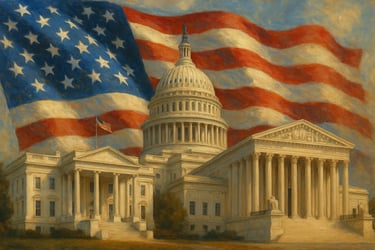
Federal Limitations and States' Rights - Part 1
A review of federal limitations as seen through the eyes of the 10th Amendment.
Steven A. Carlson
5 min read
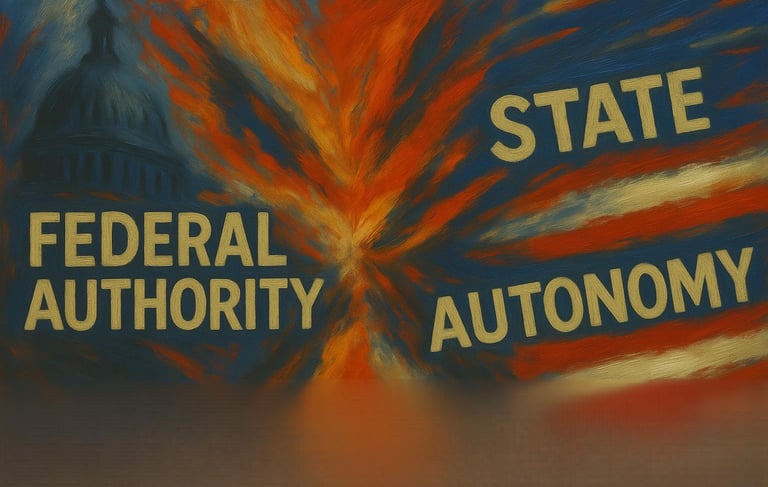
Concerning the 10th Amendment
The powers not delegated to the United States by the Constitution, nor prohibited by it to the States, are reserved to the States respectively, or to the people.
The process to ratify the U.S. Constitution was challenging, and debates regarding both the benefits and detriments of the document were often intense. One prominent dissenting voice was Patrick Henry, who contended that the Constitution, as it was drafted, conferred too much power to the federal government. The 10th Amendment was created to alleviate such apprehensions.
Disagreements about the interpretation of the 10th Amendment can be observed in the initial discussions over the exact wording of the text. Those who wished to diminish the federal government's authority (referred to as Anti-Federalists) sought slightly different phrasing than what ultimately made it into this amendment. They advocated for the wording: The powers not expressly delegated to the United States…, which had appeared in the Articles of Confederation. They believed that including this phrasing would help prevent the federal government from exceeding its bounds. Conversely, others (known as Federalists) worried that such wording could hinder the federal government.
Is there a significant difference between powers not delegated and powers not expressly delegated? Both camps recognized a distinct difference between these two phrases. However, Federalists reassured Anti-Federalists that, while granting the federal government some flexibility, the less stringent language was adequate to curb federal overreach. Clearly, judging by the final phrasing of the text, those who advocated for a less constrained role for the federal government prevailed. Federalists asserted that the concerns of the Anti-Federalists were unfounded. In reality, the limited scope of federal authority was prominently used as a key selling point to achieve ratification of the Constitution. James Madison, in Federalist No. 14, explicitly outlined the founders’ vision for a national government whose powers would be restricted to matters that warranted a federal solution.…
the general government is not to be burdened with the totality of powers for creating and enforcing laws. Its jurisdiction is confined to specific, enumerated objects that pertain to all members of the republic, but cannot be addressed by the individual provisions of any. The subordinate governments, which can extend their jurisdiction to the other subjects that they can individually manage, will retain their appropriate authority and operations. [1]
Disputes regarding the extent of federal authority have led to a multitude of court cases concerning the 10th Amendment. The outcomes have varied as this amendment has been weighed against the Necessary and Proper Clause of the Constitution (Article I, Section 8, Clause 18) which grants Congress the authority: To create all Laws necessary and proper for executing the aforementioned Powers, and all other Powers assigned by this Constitution to the Government of the United States, or any Department or Officer thereof.
The Anti-Federalists, who viewed their concerns over federal overreach as legitimate, did not have to wait long for validation. The conflict between the 10th Amendment and the Necessary and Proper Clause was tested early in the Supreme Court, and the ruling specifically focused on the omission of the term expressly from this amendment. In McCulloch v. Maryland, (1819), the state of Maryland attempted to obstruct the creation of a national bank, which had been a favored initiative of Alexander Hamilton. Ruling against Maryland, Chief Justice John Marshall articulated the following in the majority opinion:
Even the 10th Amendment, which was framed for the purpose of quieting the excessive jealousies which had been excited, omits the word “expressly,” and declares only that the powers “not delegated to the United States, nor prohibited to the States, are reserved to the States or to the people,” thus leaving the question whether the particular power which may become the subject of contest has been delegated to the one Government, or prohibited to the other, to depend on a fair construction of the whole instrument. The men who drew and adopted this amendment had experienced the embarrassments resulting from the insertion of this word in the Articles of Confederation, and probably omitted it to avoid those embarrassments.[2]
After McCulloch v. Maryland, the Supreme Court affirmed the federal government’s authority to control interstate commerce in Gibbons v. Ogden, (1824). Throughout the subsequent century, the courts generally upheld the doctrine asserted in John Marshall’s opinion. Consequently, the breadth of federal authority expanded significantly during the nineteenth century.
The early twentieth century witnessed court rulings that appeared to challenge the logic employed in McCulloch v. Maryland, though outcomes varied. For example, in Hammer v. Dagenhart, (1918), the Supreme Court invalidated a federal law banning child labor as an infringement on state rights. However, just two years later, the Court upheld a federal law implementing a treaty to safeguard migratory birds in State of Missouri v. Holland, (1920), rejecting the 10th Amendment objection. Later, in United States v. Sprague, (1931), relating to prohibition, the Supreme Court declared that federal power was strictly limited to what was specified in the U.S. Constitution, and that any additional authority violated the 10th Amendment. These rulings suggest that the Court has been inconsistent in its interpretation of this amendment.
The Great Depression, which commenced in 1929, led to Franklin D. Roosevelt taking over from Herbert Hoover as President of the United States in 1933. Roosevelt maintained that it was the federal government’s duty to become actively involved in economic recovery; consequently, between 1933 and 1937, Congress enacted his economic agenda, which included public work initiatives, banking reforms, the founding of Social Security, and various other programs, all under the banner of what was dubbed The New Deal.
The Supreme Court thwarted many of Roosevelt’s initiatives, asserting that they greatly exceeded the constitutional limitations placed on the federal government. The 10th Amendment played a crucial role in these rulings. Nonetheless, Roosevelt achieved a decisive reelection victory in 1936. Utilizing this political leverage, he threatened to expand the Supreme Court by adding justices who would comply with his agenda. As a result, the 10th Amendment was sidelined, and most initiatives within The New Deal were enacted.
In the ensuing years, the Supreme Court appeared to endorse a vision of government that aligned with Roosevelt’s principles. In United States v. Darby Lumber, (1941), the Supreme Court supported the federal Fair Labor Standards Act of 1938, affirming that the federal government indeed had the constitutional authority to introduce a federal minimum wage along with various labor-related statutes.
In the late twentieth century, the Court seemed to rely more heavily on the 10th Amendment in a number of cases, limiting excessive intrusion by the federal government into state autonomy. In New York v. United States, (1992), the Court ruled in favor of the state of New York, preventing the federal government from forcing upon the states certain responsibilities in relation to low-level radioactive waste. Later, in the case of Printz v. United States, (1997), the Supreme Court ruled as unconstitutional the The Brady Handgun Violence Prevention Act. This statute required state agencies to perform a background check before issuing a handgun to a buyer. According to the Court, this act “forced participation of the State’s executive in the actual administration of a federal program.”[3]
In Part 2 (upcoming) you will find reviews of some monumental federal statutes and Supreme Court decisions that have, over the course of time, allowed the federal government to insert itself more deeply into the lives of the citizenry and how those decisions have impacted the lives of everyday Americans.
[1] Madison, James, Federalist No. 14.
[2] Britannica, Tenth Amendment, United States Constitution, www.britannica.com/ topic/tenth amendment, Accessed January 26, 2026
[3] The Tenth Amendment – Definition and Famous Cases, infotracer.com, Accessed January 26, 2026.
The powers not delegated to the United States by the Constitution, nor prohibited by it to the States, are reserved to the States respectively, or to the people.
See below for contact information
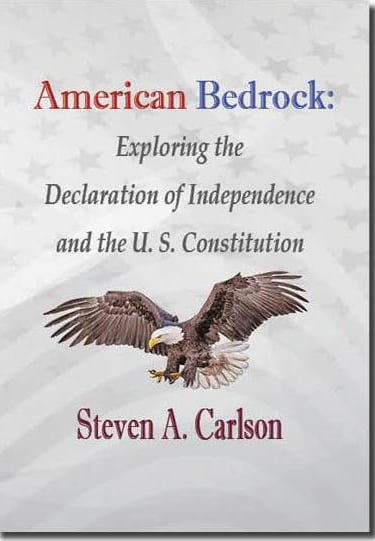
This book will truly enhance your understanding of the Declaration of Independence and the United States Constitution. Click the button below to check it out.
___________________________________________________________________________________________________________________________________________________________________________________________________


Contact
Questions? Reach out anytime.
Email:
contact@constitutionmatters.net
© 2025. All rights reserved.