

Federalist No. 5
Lessons from History
Steven A. Carlson
5 min read
Insights – Federalist No. 5 - Concerning Dangers from Foreign Force and Influence (continued) Written by John Jay Independent Journal, November 10, 1787
For several hundred years, England and Scotland battled as Scotland fought to maintain its independence. Great Britain, on the other hand, believed the two should join forces and become one nation. There were multiple geopolitical reasons England wanted to control Scotland. For instance, the fact that the two kingdoms shared a contiguous land border made Scotland a strategic interest for England who hoped to secure their northern frontier, preventing this neighbor from allying with any of England’s adversaries. This, along with the economic advantages an alliance could provide made Scotland very attractive where the British were concerned.
On July 22, 1706, after hundreds of years battling with one another, England and Scotland signed The Articles of Union, conjoining the two nations and providing Scotland with parliamentary representation. Many credit Queen Anne of England as at least partly responsible for bringing closure to that alliance based on a letter she penned to Scotland’s parliament on July 1, 1706. While an agreement had pretty much already been reached, it is argued that the letter helped the Scots to swallow what was undoubtedly a bitter pill.
In this, Federalist No. 5, John Jay invokes portions of the queen’s letter, believing it offered the citizenry powerful reasoning favoring ratification of the Constitution, and his point is well-made. In many ways, the arguments being served up in favor of ratification seemed to be echoes of statements in Queen Anne’s letter. John Jay inserted the following excerpt from that letter explaining the advantages of a single union as opposed to the development of thirteen independent nations or even a handful of confederacies comprised of three or four states each.
An entire and perfect union will be the solid foundation of lasting peace: It will secure your religion, liberty, and property; remove the animosities amongst yourselves, and the jealousies and differences betwixt our two kingdoms. It must increase your strength, riches, and trade; and by this union the whole island, being joined in affection and free from all apprehensions of different interest, will be enabled to resist all its enemies. We most earnestly recommend to you calmness and unanimity in this great and weighty affair, that the union may be brought to a happy conclusion, being the only effectual way to secure our present and future happiness, and disappoint the designs of our and your enemies, who will doubtless, on this occasion, use their utmost endeavors to prevent or delay this union.
Jay was optimistic that Anne’s letter would affect the readers for a couple of reasons. First, many, and arguably most of the state legislatures were comprised of individuals who were not just familiar with the history of England, but had, themselves, been British subjects. Second, since they had been British subjects, they would not only understand, but would even identify with the British perspective penned in Anne’s letter. As Brits, they would have favored the union between England and Scotland knowing that it would serve the interests of Great Britain.
America, the argument is given, should seek to avoid the mistakes recorded in history. While Scotland and England shared many interests and many enemies, for centuries they allowed their differences and enmity to rule the day. This, the Founders believed, would be the inevitable course for America without a solid union grounded in the firm Constitution. John Jay continued:
The potential danger of surrendering some of their independent authority to a central government was of primary concern in the thirteen colonies. Here the case is made that the dangers of jealousies and conflict between the states was equally dangerous. While two or three states might form a union, and other states would do the same, the fact is that none of those unions would remain as equal as they hoped. Eventually, one union would rise in strength, economically or militarily, and be considered by others to have a degree of superiority, which would undoubtedly lead to jealousy, bitterness, and conflict.
The history of Great Britain is the one with which we are in general the best acquainted, and it gives us many useful lessons. We may profit by their experience without paying the price which it cost them. Although it seems obvious to common sense that the people of such an island should be but one nation, yet we find that they were for ages divided into three, and that those three were almost constantly embroiled in quarrels and wars with one another. Notwithstanding their true interest with respect to the continental nations was really the same, yet by the arts and policy and practices of those nations, their mutual jealousies were perpetually kept inflamed, and for a long series of years they were far more inconvenient and troublesome than they were useful and assisting to each other. Should the people of America divide themselves into three or four nations, would not the same thing happen? Would not similar jealousies arise, and be in like manner cherished? Instead of their being “joined in affection” and free from all apprehension of different interests,” envy and jealousy would soon extinguish confidence and affection, and the partial interests of each confederacy, instead of the general interests of all America, would be the only objects of their policy and pursuits.
They who well consider the history of similar divisions and confederacies will find abundant reason to apprehend that those in contemplation would in no other sense be neighbors than as they would be borderers; that they would neither love nor trust one another, but on the contrary would be a prey to discord, jealousy, and mutual injuries; in short, that they would place us exactly in the situations in which some nations doubtless wish to see us, viz., formidable only to each other. From these considerations it appears that those gentlemen are greatly mistaken who suppose that alliances offensive and defensive might be formed between these confederacies, and would produce that combination and union of wills of arms and of resources, which would be necessary to put and keep them in a formidable state of defense against foreign enemies.
…like most other bordering nations, they would always be either involved in disputes and war, or live in the constant apprehension of them. The most sanguine advocates for three or four confederacies cannot reasonably suppose that they would long remain exactly on an equal footing in point of strength, even if it was possible to form them so at first; but, admitting that to be practicable, yet what human contrivance can secure the continuance of such equality? Independent of those local circumstances which tend to beget and increase power in one part and to impede its progress in another, we must advert to the effects of that superior policy and good management which would probably distinguish the government of one above the rest, and by which their relative equality in strength and consideration would be destroyed.
Without the U.S. Constitution and a strong federal government to unite and protect them, conflict between the states would be inevitable. Not only would conflict be inevitable, but it would play into the hands of, and be encouraged by, other nations that might benefit from internal division in a weakened America. History is again recalled as a matter of illustration.
To those who doubted the wisdom of constitutional ratification, John Jay relied on the lessons of history with which the colonists were all too familiar. They were lessons from the motherland where the colonists would have undoubtedly favored the strength of the union. His point was that if independent nations were best-served historically through alliance/union, the same reasoning should be applied when considering the union of the United States of America.
------------------------------------------------------------------------------If you enjoyed this article, please encourage your friends to visit us here at constitutionmatters.net where the Constitution really does matter. Also, if you appreciate the articles and insights provided here, feel free to contribute to the cause by clicking below.
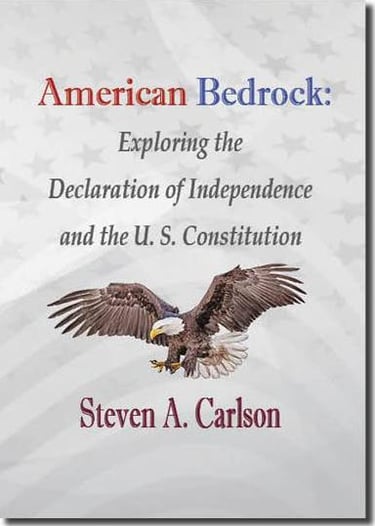
This book will truly enhance your understanding of the Declaration of Independence and the United States Constitution. Click the button below to check it out.
______________________________________________________________________________________________________________________________________________________________________________


Feel free to visit restoretheword.com
Contact
Questions? Reach out anytime.
Email:
contact@constitutionmatters.net
© 2025. All rights reserved.