
Federalist/Anti-Federalist Introduction
Concerning the U.S. Constitution
Steven A Carlson
3 min read

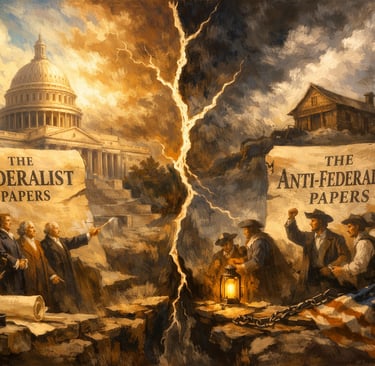
The U.S. Constitution, penned and approved by colonial delegates in 1787, would not become the foundational document of the United States unless and until it was ratified by at least nine of the thirteen colonies. Prior to the U.S. Constitution, federal governance was grounded in the Articles of Confederation. This was a document that loosely defined the role of the government as the colonists fought for their freedom from England. However, to many of the Founding Fathers, the authority
In late 1787, the proposed Constitution was submitted to the thirteen colonies in hopes that at least nine colonies would findit acceptable. In that vein, a number of articles, known as the Federalist Papers, were printed in newspapers over the next several months in an effort to influence the ratification process, encouraging the states to buy into the principles established in the document.
The Federalist Papers, all penned under the pseudonym Publius, were actually authored by Alexander Hamilton, James Madison, and John Jay – names that would not be made public for roughly another decade. In those articles, the three men pointed to what they saw as the positive benefits provided in the proposed Constitution, insisting that it would establish a strong but non-intrusive federal government, allowing states the independence to self-govern without undue federal intervention.
Some readers have undoubtedly heard the term Federalist Papers, though it is doubtful that very many have read them. Indeed, reading these documents can be tedious as they deal at length with governmental matters and details about how the federal government is supposed to operate. Consequently, they are not the most exhilarating of documents, and it can be a heavy challenge to wade through them.
What many do not know is that, alongside the Federalist Papers was another set of articles, known as the Anti-Federalist Papers. Penned by a number of authors under assorted pseudonyms like Brutus, Federal Farmer, Cato, Centinel, Agrippa, and Columbian Patriot, these pseudonyms served to mask the actual authors, which included men like George Clinton, Melancton Smith, Robert Yates, Elbridge Gerry, and Patrick Henry.
The goal of the Anti-Federalist Papers was to dispute the positive outlook that was displayed in the Federalist Papers concerning the proposed Constitution. The people had been promised a union where primary authority would lie with the states. The authors of the Anti-Federalist Papers strongly argued that the proposed document, if ratified, would place far too much power and authority in a centralized federal government, leaving the states subject to the whims of federal leadership as opposed to the federal government answering to the various states.
The Federalist Papers consisted of 85 articles arguing for ratification of the proposed Constitution. Interestingly, there were an equal number of Anti-Federalist articles (85), intended to offset what was seen as the propaganda-filled Federalist Papers. These essays represent two pivotal documents in American political history, debating the principles and structure of the government created by the U.S. Constitution. The former advocated for the ratification of the Constitution, while the latter argued against it, reflecting concerns over risks to personal liberties under a too powerful federal government.
The Federalist Papers and Anti-Federalist Papers not only reflect the political climate of their time but also lay the groundwork for ongoing discussions surrounding governance, rights, and the balance of power in American society. They serve as a testament to the founders' understanding of the complexities of human nature and the necessity of building a government that is both strong and accountable. The legacy of these papers extends far beyond their historical context, continuing to inform debates about federalism and individual rights even today.
Beginning on July 23, 2026, the objective here at constitutionmatters.net is to provide readers with valuable insight into both the Federalist Papers and Anti-Federalist Papers. Each Thursday an article will be offered providing a look into the positions of the Founding Fathers on both sides of the aisle. For instance, on July 23rd, a deeper look into Federalist No. 1 will be offered, addressing arguments favoring ratification. The following week, Anti-Federalist No. 1 will be reviewed, offering readers the opposing perspective. The hope is that these weekly articles, written plainly and concisely, will provide a deeper understanding of the founding of this nation. You, the reader, will be able to consider both sides of the debates and decide for yourself which are stronger and which side was more accurate about the future of this nation under the U.S. Constitution.
granted to the federal government in the Articles was deemed too weak for that government to be able to sustain a nation on a long-term basis.
This book will truly enhance your understanding of the Declaration of Independence and the United States Constitution. Click the button below to check it out.
______________________________________________________________________________________________________________________________________________________________________________


Feel free to visit restoretheword.com
Contact
Questions? Reach out anytime.
Email:
contact@constitutionmatters.net
© 2025. All rights reserved.