
Anti-Federalist No. 6
Steven A. Carlson
5 min read
The evils of anarchy have been portrayed with all the imagery of language in the growing colors of eloquence; the affrighted mind is thence led to clasp the new Constitution as the instrument of deliverance, as the only avenue to safety and happiness. To avoid the possible and transitory evils of one extreme, it is seduced into the certain and permanent misery necessarily attendant on the other. A state of anarchy from its very nature can never be of long continuance; the greater its violence the shorter the duration. Order and security are immediately sought by the distracted people beneath the shelter of equal laws and the salutary restraints of regular government; and if this be not attainable, absolute power is assumed by the one, or a few, who shall be the most enterprising and successful. If anarchy, therefore, were the inevitable consequence of rejecting the new Constitution, it would be infinitely better to incur it, for even then there would be at least the chance of a good government rising out of licentiousness.[1]
According to the Federalist Papers, the chaos resulting from a failure to retify the constitution must be avoided at ll costs. Even if the constitution was not perfect in every sense of the word, it must be considered far superior than the weak government established under the Articles of Confederation and certainly better than an assortment of smaller confederacies. However, Centinel argues that approving the constitution would be nothing more than a rush into despotism, which is simply monarchy by another name.
According to Centinel, those advocating for ratification were running a campaign of fear. The claim here is that people do not make their best decisions under duress – particularly when duress involves warnings of frightening consequences. The claims that a nation divided into separate confederacies would ignite dangerous, warring rivalries Here Centinel calls the claim a hobgoblin dreamed up by irrational minds.
But to rush at once into despotism because there is a bare possibility of anarchy ensuing from the rejection, or from what is yet more visionary, the small delay that would be occasioned by a revision and correction of the proposed system of government is so superlatively weak, so fatally blind, that it is astonishing any person of common understanding should suffer such an imposition to have the least influence on his judgment; still more astonishing that so flimsy and deceptive a doctrine should make converts among the enlightened freemen of America, who have so long enjoyed the blessings of liberty. But when I view among such converts men otherwise pre-eminent it raises a blush for the weakness of humanity that these, her brightest ornaments, should be so dimsighted to what is self-evident to most men, that such imbecility of judgment should appear where so much perfection was looked for.[2]
He might have spared his readers the fatigue of wading through his long-winded disquisitions on the direful effects of the contentions of inimical states, as totally inapplicable to the subject he was professedly treating; this writer has devoted much time, and wasted more paper in combating chimeras of his own creation. However, for the sake of argument, I will admit that the necessary consequence of rejecting or delaying the establishment of the new constitution would be the dissolution of the union, and the institution of even rival and inimical republics; yet ought such an apprehension, if well founded, to drive us into the fangs of despotism? Infinitely preferable would be occasional wars to such an event. The former, although a severe scourge, is transient in its continuance, and in its operation partial, but a small proportion of the community are exposed to its greatest horrors, and yet fewer experience its greatest evils; the latter is permanent and universal misery, without remission or exemption. As passing clouds obscure for a time the splendor of the sun, so do wars interrupt the welfare of mankind; but despotism is a settled gloom that totally extinguishes happiness.[4]
The other specter that has been raised to terrify and alarm the people out of the exercise of their judgment on this great occasion, is the dread of our splitting into separate confederacies or republics, that might become rival powers and consequently liable to mutual wars from the usual motives of contention. This is an event still more improbable than the foregoing. It is a presumption unwarranted, either by the situation of affairs, or the sentiments of the people; no disposition leading to it exists; the advocates of the new constitution seem to view such a separation with horror, and its opponents are strenuously contending for a confederation that shall embrace all America under its comprehensive and salutary protection. This hobgoblin appears to have sprung from the deranged brain of Publius, [The Federalist] a New York writer, who, mistaking sound for argument, has with Herculean labor accumulated myriads of unmeaning sentences, and mechanically endeavored to force conviction by a torrent of misplaced words.[3]
Surprisingly, Centinel does admit, in the ensuing remarks, that rejecting the constitution may well lead to the establishment of separate confederacies, only because it may well be the natural progression in America. Still, he raises the argument that such a state of events, even if it resulted in interstate rivalries and conflicts, would seem preferable to diving instantly into a cesspool of despotism.
The concluding words in this essay sound a bit confusing. They are not complimentary, as the opening statement suggests. Instead, the comments are intended as derogatory. He is, in scurrilous fashion, congratulating his opponents on their pseudo-ability to so easily design the one perfect government in all of history that could never be undone by the ambitions and imperfections of men.
I congratulate my fellow citizens that a good government, the greatest earthly blessing, may be so easily obtained, that our circumstances are so favorable, that nothing but the folly of the conspirators can produce anarchy or civil war, which would presently terminate in their destruction and the permanent harmony of the state, alone interrupted by their ambitious machinations. CENTINEL [5]
________________________
Anti-Federalist 6
Ibid
Ibid
Ibid
Ibid
Insights – Antifederalist No. 6 THE HOBGOBLINS OF ANARCHY AND DISSENSIONS AMONG THE STATES Some historians feel most of the "Centinel" letters were written by Samuel Bryan, and perhaps a few by Eleazer Oswald, owner of the Independent Gazetteer. A more recent study by does not necessarily support those claims.
The authors of the Federalist Papers warned of severe anarchy, or chaos, should the people fail to ratify the proposed constitution. Much of that argument was offered through the lens of the states developing a number of independent confederacies – a claim already denied in previous Anti-Federalist Papers. Writing under the pseudonym “Centinel,” this writer accused those authors of making a straw-man’s argument. In essence, they were arguing against something the Anti-Federalists had never said.
From the Federalist point of view, the constitution must be ratified, else the United States would be thrown into chaos. Centinel insists that anarchy would actually be preferable to the fallacious promises of the constitution. Anarchy, he claims in the following remarks, would eventually and inevitably lead to a more reasoned form of government than could be expected under the current proposal.
------------------------------------------------------------------------------If you enjoyed this article, please encourage your friends to visit us here at constitutionmatters.net where the Constitution really does matter. Also, if you appreciate the articles and insights provided here, feel free to contribute to the cause by clicking below.
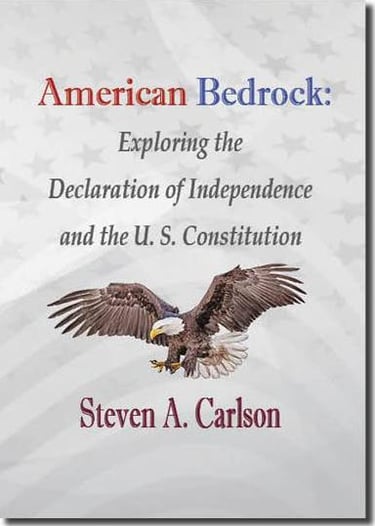
This book will truly enhance your understanding of the Declaration of Independence and the United States Constitution. Click the button below to check it out.
______________________________________________________________________________________________________________________________________________________________________________
Feel free to visit restoretheword.com
Contact
Questions? Reach out anytime.
Email:
contact@constitutionmatters.net
© 2025. All rights reserved.