Birthright Citizenship and a Typhlotic Courtroom Lesson 6: Oral Arguments
A disturbing case of the blind leading the blind
Steven A. Carlson
16 min read

To see a list of all commentaries, click the above picture.
Birthright Citizenship and a Typhlotic Courtroom - Lesson 2: The 14th Amendment
Birthright Citizenship and a Typhlotic Courtroom - Lesson 3: The Reconstruction Era
Birthright Citizenship and a Typhlotic Courtroom - Lesson 4: Wong Kim Ark
Birthright Citizenship and a Typhlotic Courtroom - Lesson 5: 20th Century U.S. Citizenship
Dear Visitor:
Thank you for your interest in constitutionmatters.net. Please be advised that in order to fully appreciate this commentary, it would be wise to first read Lessons 1 - 5 of this series. Those lessons provide valuable foundational support for what you will read here. They can be found under Constitution Commentaries or Commentaries Alphabetical Listing in the menu at the top of the page.
Down to Brass Tacks
It is difficult to say which of the following statements better reflects reality:
1. It was time very well spent.
2. It was two hours of my life I will never get back.
1. As noted in Part 5 of this series, children born in England were not citizens of England as we count citizenship. Instead, they were considered subjects of the crown. What is the difference? In England, a citizen is someone with full legal rights under the state. It is a status specifically bestowed by the state. A subject, on the other hand, is simply considered a permanent resident. A subject is a term describing someone under the authority and protection of the Crown, but with fewer rights and lacking a political voice. Subjects are still held legally accountable to the state.
2. In oral arguments, certain justices leaned heavily on the long history of the recognition of English common law in the U.S. Generally speaking, it is true that much U.S. law reflects English common law. Where birthright citizenship was concerned, they cited the use of common law going back to the earliest days of the colonies in the early 1600’s.
However, that theory is flawed on two counts. First, those who were born here in those early days were not U.S. citizens. They were British subjects. The U.S. did not exist until 1776. Second, from 1776 through 1898 (the first 122 years of existence), there is no record, historical or legal, of citizenship via English common law in the U.S. This was true even decades after the ratification of the 14th Amendment.
General Sauer did make the point that, other than the designation of the children of slaves in 1868, both prior to and after the 14th Amendment, birthright citizenship was not recognized in the U.S. It was not mentioned in any immigration and naturalization acts of the late 18th and early 19th centuries. In fact, even after the Court’s decision in United States v Wong Kim Ark in 1898, birthright citizenship was not practiced. However, the justices seemed to dismiss that most relevant argument.
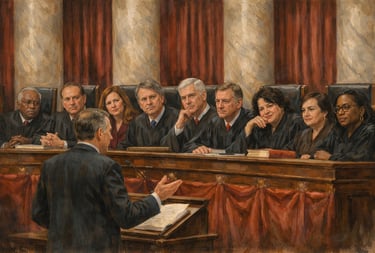
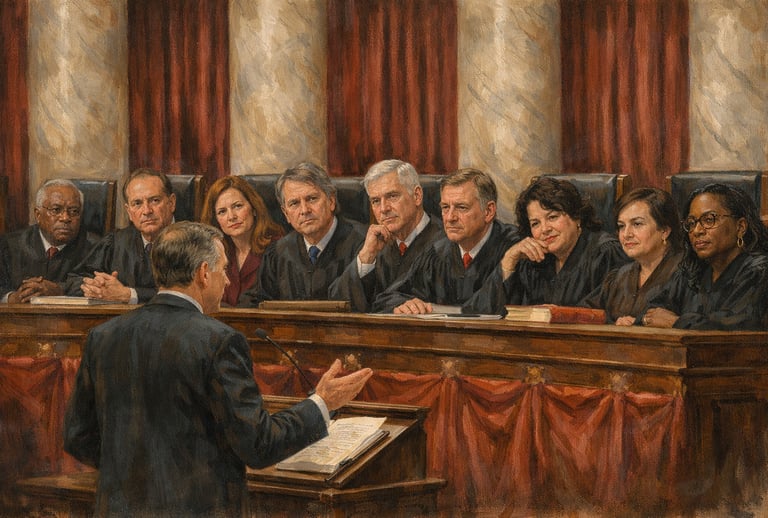
These are my thoughts after having listened attentively to the two hours of oral arguments before the U.S. Supreme court that took place on April 1, 2026. Under consideration was President Trump’s executive order denying birthright citizenship to the children of illegal immigrants born in the United States. As far as oral arguments go, it seemed rather underwhelming.
By underwhelming, first I mean that the arguments offered by both attorneys – General D. John Sauer on behalf of the government and Ms. Cecelia D. Wang on behalf of the Respondents – were less than impressive. Second, it was disappointing to hear the questions and issues raised by the nine justices as they inquired from the bench. Yet, what may have been even more important were certain questions and observations that were not raised either by the justices or the attorneys.
General Sauer seemed to start out on the right foot, delving into the idea of original intent of the 14th Amendment where the terminology “subject to the jurisdiction thereof” is concerned. He cited Senator Lyman Trumbull (1813-1896) of Illinois who helped author the clause, providing a clear explanation of the intent of the terminology. When asked the meaning Trumbull responded, “subject to the complete jurisdiction thereof, not owing allegiance to anybody else.” General Sauer then backed up that claim noting that in 1884 this very meaning was employed by the Supreme Court in Elk v Wilkins, notwithstanding the fact that the case involved a Native American.
What follows are a list of matters that either went unmentioned or were not given the weight they probably deserved as well as matters that were arguably over-emphasized..
English Common Law
The court made much of English common law. According to the justices, under common law, children born in the country were considered citizens without regard to the citizenship status of the parents. However, there are two issues with the court relying on common law.
This response by General Sauer was disappointing. His answer should have been that the Court’s 1898 decision in Wong Kim Ark misconstrued the 14th Amendment. In part, in the Wong Kim Ark decision, the Court relied on the principle of English common law. As stated above, common law with respect to birthright citizenship was not applied in the United States once independence was declared in 1776.
The Court also leaned on the phraseology of the 14th Amendment: “All persons born or naturalized in the United States, and subject to the jurisdiction thereof, are citizens of the United States…” General Sauer would have done well to point to the disparate applications of the 14th Amendment between United States v Wong Kim Ark and Elk v Wilkins. In Elk v Wilkins the Court viewed the 14th Amendment very narrowly, insisting that it could not apply the amendment outside of its original context, which was the citizenship of former slaves. In Wong Kim Ark the Court stretched its application of the amendment very broadly, which was never the intent. The case should have been decided under The Naturalization Act of 1802 and not the 14th Amendment.
These things having been said, Justice Sotomayor was wrong in suggesting that the government was seeking to overturn Wong Kim Ark. President Trump’s executive order deals only with the children of foreigners who are in the U.S. unlawfully or who are in the country as temporary visitors. Wong Kim Ark’s parents were legal U.S. residents for more than thirty years, so that case has no direct bearing on the executive order.
Same Old Constitution
Especially disheartening was an exchange between Justice Roberts and General Sauer. The General was asked concerning birth tourism, which is seen as a critical issue here in the U.S. Certain countries, and especially China, have been sending women to America specifically to have children who are deemed U.S. citizens.
Those children are then returned to and raised in Communist China with no allegiance or political loyalty toward the U.S. This has been happening for a couple of decades. The concern is that in very short order these children will begin reaching the age where they will be able to vote in U.S. elections. Indeed, this has become a major industry and, as General Sauer points out, the evidence is plain that the goal is to stealthily subvert the U.S. political system,
JUSTICE SOTOMAYOR: …Wong Kim Ark does a wonderful job of laying out the English rule. And you claim it was different, but there isn't any treatises or scholars who say it's different. English rule was always by birth. Other people were not by -- other countries were not by birth.
Let me just go to the implications of what you're asking us to do. You are asking us to overrule Wong Kim Ark. Well, there, Wong Kim Ark's parents were domiciled in the U.S., but they owed loyalty to China. They eventually returned to China.
So they didn't have a primary allegiance to the United States. So you're not asking that. Are you asking us to overrule then our cases, one of which said that a child of illegal aliens could be -- was a citizen? You're asking us to overrule that?
GENERAL SAUER: No. First of all, we're not asking you to overrule Wong Kim Ark. We agree with the holding of Wong Kim Ark --
Wong Kim Ark
The Court spent considerable time discussing the 1898 court case of United States v Wong Kim Ark. In 1898, the Court found that Wong Kim Ark was, indeed, a citizen of the United States. He was born in the U.S. and his parents, subjects of China, lived here for more than three decades before returning to China. Following is a portion of an exchange between Justice Sotomayor and General Sauer during oral arguments that focused on that case:
CHIEF JUSTICE ROBERTS: Thank you, counsel. You mentioned in your briefing and also this morning the problem of birth tourism. Do you have any information about how common that is or how significant a problem it is?
GENERAL SAUER: It's a great question. No one knows for sure. There's a March 9th letter from a number of members of Congress to DHS saying do we have any information about this. The media reports indicate estimates could be over one – a million or 1.5 million from the People's Republic of China alone.
The Congressional Report that we cite in our brief talks about certain hot spots like Russian elites coming to Miami through these birth tourism companies.
And, I mean, here's a fact about it that I think is striking. Media reported as early as 2015 that based on Chinese media reports, there are 500 birth tourism companies in the People's Republic of China whose business is to bring people here to give birth and return to that nation.
CHIEF JUSTICE ROBERTS: Having said all that, you do agree that that has no impact on the legal analysis before us?
GENERAL SAUER: I think it's – I quote what Justice Scalia said in his Hamdan dissent, where they had -- where, like, their interpretation has these implications that could not possibly have been approved by the 19th century Framers of this amendment. I think that shows that they've made a mess -- their interpretation has made a mess of the provision.
CHIEF JUSTICE ROBERTS: Well, it certainly wasn't a problem in the 19th century.
GENERAL SAUER: No, but, of course, we're in a new world now, as Justice Alito pointed out to, where 8 billion people are one plane ride away from having a child who's a U.S. citizen.
CHIEF JUSTICE ROBERTS: Well, it's a new world. It's the same Constitution (Laughter).
The Chief Justice probably felt a sense of personal satisfaction when the crowd responded to his one-liner with laughter, but he should not have. The notion that over the coming two decades millions of Chinese subjects, raised under Communist rule, might legally vote in American elections is demoralizing. Indeed, there will come a time any one of them would even be eligible to run for president of the United States. To ask such a sober question and then dismiss it so casually, as if a joke, demonstrates a disturbing lack of respect for the value of U.S. citizenship. Justice Roberts likely does not see it that way, but it is easy to see why many, including yours truly, would take offense.
Despite the justice’s irreverent quip, his first response where he stated, “…you do agree that that has no impact on the legal analysis before us?” is both puzzling and disappointing. If the justice believed birth tourism had no bearing, why raise the issue at all? I’m sure it was mentioned in the brief, but the justice inserted the topic in the form of a supposedly serious inquiry only to then dismiss it with a flippant remark.
I am a constitutionalist and no one appreciates more that the U.S. Constitution, including its 27 amendments, should be taken at face value and the meaning determined from the original wording and intent. That having been said, today’s birth tourism is extremely relevant when it comes to the original intent of the 14th Amendment. While the justices fiddled with what the original intent might have been, given the wording of the text, there is no need to guess about that intent. It was a very narrow meaning well-displayed in the debates surrounding the amendment. The purpose was to establish U.S. citizenry for former slaves and their families during Reconstruction. Indeed, that meaning and context were then soundly confirmed in the decisions in the Slaughterhouse cases and Elk v Wilkins shortly thereafter. Consequently, there is no reason for any of the justices to banter about original intent.
General rules v Original Intent
The back-and-forth between the General and the justices was sometimes dizzying. However, there was one exchange that was significant – albeit not in the way most understood it. The following exchange occurred during oral arguments between Justice Alito and General Sauer.
JUSTICE ALITO: General, can I take you back to the Chief Justice's question about the specific exceptions to birthright citizenship that everybody seems to agree were recognized under the common law.
And it brings up an important principle about how we interpret the law. When particular problems pop up, lawmakers may enact a general rule. When they do that, is the application of that general rule limited only to the situations that they had in mind when they adopted the general rule, or do we say they adopted a general rule, they meant for that to apply to later applications that might come up?
Justice Scalia had an example that dealt with this situation. He imagined an old theft statute that was enacted well before anybody conceived of a microwave oven, and then afterwards someone is charged with the crime of stealing a microwave oven, and this – this fellow says: Well, I can't be convicted under this because a microwave oven didn't exist at that time. And he dismissed that. There's a general rule there and you apply it to future applications. And what we're dealing with here is something that was basically unknown at the time when the Fourteenth Amendment was adopted, which is illegal immigration. So how do we deal with that situation when we have a general rule?
GENERAL SAUER: Yeah, I strongly agree with the way that you framed it, that there is a general principle that's a broad principle that's adopted in the phrase "subject to the jurisdiction thereof."
And we submit that our theory of allegiance and domicile-based allegiance is what explains those specific exceptions that everybody was aware of, but it is broad enough to sweep in future situations. And, as you pointed out, illegal immigration did not exist then.
Now the problem of temporary visitors exists. And it's very interesting that as you look at pages 26 to 28 of our brief, commentators going from, you know, 1881 until 1922 are uniformly saying that children of temporary visitors are not included. Now that logic, we say, naturally extends. It's really an a fortiori case. If you have someone who enters illegally, by the 1880s, there are restrictions on immigration.
If you've entered illegally, it's kind of, you know, a well-established principle of law going back to the Code of Justinian that says you're not allowed to be there, you cannot – you don't have the legal capacity to create domicile there.
While the exchange was informative, there are two larger points to consider that are completely absent from the conversation. How a general principle, or rule, might apply in an unanticipated circumstance is a worthwhile discussion, and the general’s point about the meaning of the phrase, “subject to the jurisdiction thereof” was well-made. However, Justice Samuel Miller, in the majority decision in the Slaughterhouse cases, stated plainly that the 14th Amendment was not intended as a general rule. Writing about the joint purpose of the 13th, 14th, and 15th Amendments, he wrote:
The most cursory glance at these articles discloses a unity of purpose, when taken in connection with the history of the times, which cannot fail to have an important bearing on any question of doubt concerning their true meaning… on the most casual examination of the language of these amendments, no one can fail to be impressed with the one pervading purpose found in them all, lying at the foundation of each, and without which none of them would have been even suggested; we mean the freedom of the slave race, the security and firm establishment of that freedom, and the protection of the newly made freeman and citizen from the oppressions of those who had formerly exercised unlimited dominion over him. It is true that only the fifteenth amendment, in terms, mentions the negro by speaking of his color and his slavery. But it is just as true that each of the other articles was addressed to the grievances of that race, and designed to remedy them as the fifteenth.
Justice Miller, who wrote these words a mere five years after the ratification of the 14th Amendment and even noted the freshness of those events in the mind of everyone, explained the clear intent without stumbling over his words. Taken at face value, his words reveal that, but for the purpose of freeing the slaves, these three amendments would not exist as they do. The fact that the Court, in Wong Kim Ark, took an amendment that was intended to be viewed narrowly and applied it as though it was a general rule does not muddy the clarity of Justice Miller’s words. The Court’s decision in United States v Wong Kim Ark turned that original intent on its ear and, in due time, opened the floodgates of birthright citizenship.
A second matter absent from the discussion was what occurred 75 years prior to United States v Wong Kim Ark. President Monroe, in 1823, introduced the Monroe Doctrine. This was a paper focused on international relations and served as a warning to other nations – specifically European nations – to abstain from political interference in the United States. The policy also served as a pledge that the United States would respect the sovereignty of those nations as well. The policy made four specific points.
1. The United States would not interfere with the internal affairs of those European nations.
2. The United States would not interfere with existing European colonies currently existing in the Western Hemisphere.
3. The Western Hemisphere was closed to further colonization.
4. Any attempt by a European power to oppress or control any nation in the Western Hemisphere would be considered an act of hostility.
------------------------------------------------------------------------------If you enjoyed this article, please encourage your friends to visit us here at constitutionmatters.net where the Constitution really does matter. Also, if you appreciate the articles and insights provided here, feel free to contribute to the cause by clicking below.
The Monroe Doctrine was broad in scope and encompassed more than just the United States. President Monroe essentially took the entire Western Hemisphere under his wing and warned those across the ocean that the new policy was hands off. An important point should be made here. It is a secondary matter, but still quite relevant to the discussion.
Justice Alito discussed the principle of general rules and how they might be applied in differing, more modern circumstances. The Monroe Doctrine was directed specifically toward European nations in 1823. Why? Well, at the time other continents like Africa and Asia were not threats to the Western Hemisphere. However, that is not true today. In fact, few would deny that our primary threats come from Asia. While the Monroe Doctrine does not carry the weight of a constitutional amendment, it is still relevant. It stands to reason, then, that those same pledges and cautions (general rules) aimed at European nations in 1823 would equally apply to certain other nations in 2026.
Now it is time to view birthright citizenship through the lens of original intent even more closely. While Justice Miller, in the Slaughterhouse cases, explained in unequivocal terms the original intent of the 14th Amendment, there is far more to consider. In fact, there are arguably far greater matters to consider. For instance, it is important to recognize what Congress absolutely did not intend as a result of the 14th Amendment in 1868.
The Monroe Doctrine precludes other nations from interfering with the sovereignty and political decisions of the Western Hemisphere – particularly the United States. This is a simple principle that is easy enough to understand. However, something happened in 1980 that changed everything. In 1980, Fidel Castro of Cuba unloaded 125,000 Cubans, sending them to the United States. Far too many of those individuals were what might be considered undesirables – prisoners, mental patients, etc. Peter Schweitzer has detailed this in his recent book titled The Invisible Coupe, which is a worthwhile read.
Cuba’s devious move impressed other nations who then began to focus on other means by which they could meaningfully infiltrate and undermine the United States political system. Much of this has been accomplished directly, with the help of individuals and groups within the U.S., through illegal immigration. However, the 14th Amendment was seen by other countries as an opportunity to not only infiltrate the country, but an effective means to circumvent the Monroe Doctrine. Today, entire foreign industries have been established where pregnant women are shipped off to the United States to give birth. The child, born on U.S. soil, is automatically granted U.S. citizenship. The mother and child are then returned to their home country where the child is raised in what is often an environment hostile to the U.S. According to Peter Schweitzer, this is especially true in China.
In his book, Mr. Schweitzer noted that, beginning in the year 2030, we can anticipate the first wave of Chinese-American voters, and that number will grow with each passing election year. Sadly, through the Court’s misapplication of the 14th Amendment in 1898, the U.S. is guilty of providing other nations with the means and opportunity to enter through a back door and subvert the country from within. Many insist that the 14th Amendment is a general statement with respect to birthright citizenship, despite strong evidence that this was not the intent. However, one thing of which we can be sure is this: ratification of the 14th Amendment was never intended to provide an opportunity for scheming adversaries to circumvent our policies and undermine our political system. It was not intended to give people the means to skirt our naturalization system or policies like the Monroe Doctrine. As Peter Schweitzer put it in an interview, the framers could not have intended the 14th Amendment as a suicide pact for their country.
Unfortunately, the arguments laid out in this series were not presented during oral arguments before the Supreme Court. Then again, presenting these arguments may have made no difference since, given the nature of the queries from the justices, one could infer that most justices made their decisions prior to oral arguments, although I hope that is not the case. What seemed evident, though, is that most justices were accepting of the idea that birthright citizenship in the 14th Amendment was intended as a general principle. If that is the mindset of the Court, they will undoubtedly strike down President Trump’s executive order.
While the outlook is not particularly bright, there is one option open to the Court that could arguably be the preferred constitutionally valid decision. The Court could rule that the language of the 14th Amendment cannot be defined in, and is beyond the scope of, an executive order. This would be a just rendering, and it would leave open the opportunity for Congress to consider legislation that could better define the amendment’s language. However, one thing is clear. The framers of the 14th Amendment did the U.S. no favors by inserting the arguably ambiguous clause, “All persons born or naturalized in the United States and subject to the jurisdiction thereof, are citizens of the United States and of the State wherein they reside.”
This concludes this 6-part series on birthright citizenship. For those who are so inclined, if you appreciate the perspective offered in this series, please feel free to share this link. Also, please encourage your friends to visit constitutionmatters.net, where the Constitution really does matter.
This book will truly enhance your understanding of the Declaration of Independence and the United States Constitution. Click the button below to check it out.
___________________________________________________________________________________________________________________________________________________________________________________________________


Contact
Questions? Reach out anytime.
Email:
contact@constitutionmatters.net
© 2025. All rights reserved.