
Busting the Filibuster
Insight into how eliminating the filibuster would impact Washington DC
BLOG
Steven A. Carlson
8 min read
To see a list of all commentaries, click the above picture.


Separation of Church and State - Part 1

Separation of Church and State - Part 2


Being a Constitutionalist
Word Play and Political Demagoguery
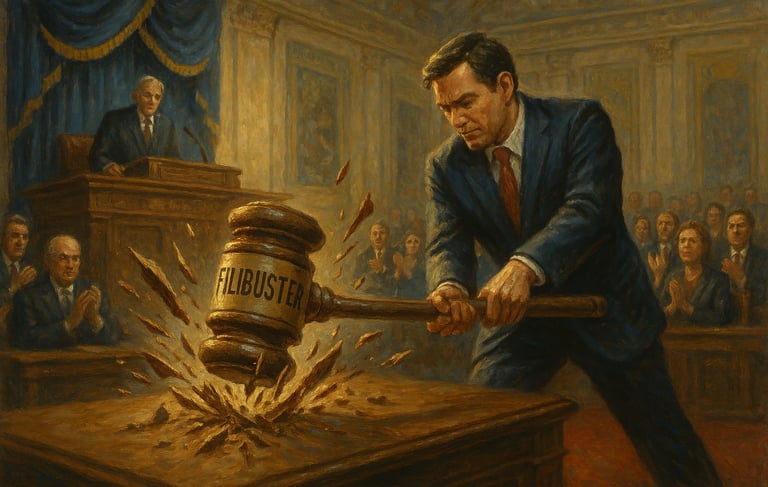
These and other options are available to circumvent a filibuster or, as they can now be called, pseudo-filibusters, since no filibuster actually takes place. The difficulty with these procedures is that each one requires a minimum 51 votes. However, there are enough Republicans who are in love with and committed to the filibuster that attaining 51 votes is a challenge. Those Senators believe eliminating the filibuster would make the Senate look too much like the House of Representatives. That is certainly an understandable position, but it lacks foresight.
Currently Republicans have a strong hold on the Senate majority and there are certain matters, like the S.A.V.E. Act, that can only pass when Republicans are in charge. Additionally, there may come a day when Democrats will, once again, hold the majority and as has been pointed out by analysts and pundits, Democrats will surely be opportunistic and eliminate the filibuster to override Republicans on every bill the Democrats favor. Consequently, from a Republican perspective, if there is a time to end the filibuster, it is now. If that does not happen and things like the S.A.V.E. Act go by the wayside, this opportunity may be lost forever.
In May, there will be a runoff for the Republican nomination for a U.S. Senate seat in Texas. The runoff will be between current Senator John Cornyn and current Texas Attorney General Ken Paxton. The two ran for the position in the Texas Republican primary. However, since neither gentleman received more than 50% of the vote due to the presence of a third candidate, the winner of the May runoff will run as the Republican nominee in the general election.
It is no secret that John Thune, Republican majority leader in the Senate, would prefer to see Cornyn returned to the Senate since he considers Paxton too closely aligned with Donald Trump. On the other hand, Paxton would like to see the S.A.V.E. Act passed. In that vein, Paxton has made an offer, and it is one that might be difficult for Thune and Cornyn to ignore. Paxton has offered to step aside and withdraw his bid for the Senate if Thune will take the steps necessary to override the filibuster rules to get the S.A.V.E. Act through the Senate. While Thune currently refuses to make that move, partly because he does not want to shake things up in the Senate and partly because he is not particularly thrilled about the S.A.V.E. Act, he does want Cornyn back in the Senate. Consequently, Paxton's move has placed Thune in a bind. If he does not move to allow a Senate vote on the S.A.V.E. Act, a bill that is highly favored by Republicans, it will provide Paxton with better than even odds to win in the May runoff.
Adding to the drama surrounding the S.A.V.E. Act and the filibuster, President Trump has now jumped into the fray. He has pledged to refuse to sign any bills coming from Congress until the S.A.V.E. Act is passed. This pledge, however, could be problematic since a bill does not require the president's signature in order to become law. If a bill comes to the president's desk and he does nothing, the bill will automatically become law after ten days of inaction. Consequently, the president would need to veto a bill to prevent it from becoming law even if it is something he favors. It will certainly be interesting to watch this battle play out.
Introducing the Filibuster
When a bill is brought before one of the congressional chambers, whether the House or the Senate, members first engage in a debate. The format of this process varies slightly between the two chambers. In the House of Representatives, a debate consists of a discussion on the advantages and disadvantages of the proposed legislation. In contrast, Senate rules allow for a practice known as a filibuster. This enables a Senator to effectively hold the Senate's proceedings hostage, by refusing to yield the floor to another member. A Senator can keep speaking for an extended period. To terminate the filibuster, a vote of sixty members is required. If there is not a sufficient number of votes to end it, the speaker may continue until the proposed bill is removed from the Senate's agenda and the chamber proceeds to other matters. Unsurprisingly, this tactic is frequently employed by the minority party to hinder the majority party’s efforts to push legislation through. It acts as a protective measure for the minority party and their constituents.
The origins and application of the filibuster are somewhat unclear. It is generally acknowledged that this form of procedure was first utilized during the Roman Republic, specifically by a Senator named Cato the Younger in 60 BC. In the context of the United States, the Senate filibuster is believed to have begun around 1805/1806, though its application was quite limited until the Civil War. Notably, the first effective filibuster in the U.S. purportedly occurred in 1837. The Whig party, in 1833, censured President Andrew Jackson claiming he had overreached his authority with actions he had taken with respect to the U.S. Treasury. Toward the end of Jackson’s term, Democrats sought to expunge that censure from the congressional record. For weeks the Whigs used the filibuster to prevent the Democrats. In the end, however, the censure was removed.
Weakening the Rules
Initially, Senate rules provided no means to forcibly end a filibuster. It would end only when the speaker chose to stop speaking. This generally happened when the proposal they were filibustering was dropped. Finally, in 1917, the rules were changed as it was decided that a filibuster could be ended by a 2/3 vote (67) of the Senate (a procedure referred to as cloture). In 1975 that number was dropped to 60 votes. In recent years, however, it is rare for a filibuster to actually take place, primarily because the mere threat of a filibuster is sufficient. If the majority party knows they lack the 60 votes necessary to end the filibuster, the proposal will be dropped, and attention will be given to other matters. The logic is that a filibuster would tie up the Senate while other projects are left unresolved.
Strong arguments have been offered lately that the filibuster should either be utilized as it was originally intended or it should be discarded completely. The filibuster was intended as a rarely used instrument. In order to challenge legislation, an individual had to commit to speaking for hours/days on end to prevent a vote on legislation they opposed. The rationale behind returning the filibuster to its original format is that it demonstrates a measure of effort. If, by simply saying the word filibuster, someone can bring legislation to a halt, it demonstrates laziness by the chamber and no commitment by the individual challenging the legislation. Indeed, if someone is convicted about their point of view on a piece of legislation, that person should be willing to do more than simply speak a single word. If something is worth fighting for, or against, it deserves a debate, not just a word.
There are those, of course, who would like to see the filibuster eliminated completely. The argument is that much good legislation has been discarded over the years because someone was able, by speaking a single word, to bring a bill to a halt. In fact, it seems lately that, regardless which party is the majority in the Senate the minority party stops most bills by simply uttering that single word. After all, if someone is unwilling to commit to performing a true filibuster, it must be that they believe their debate concerning the bill would be unconvincing to the majority.
What has brought the topic of the filibuster to the forefront? There is currently a bill before the Senate concerning U.S. elections. It is called the S.A.V.E. (Safeguard American Voter Eligibility) Act and it has already passed in the House of Representatives. The legislation would require proof of citizenship to register to vote in American elections as well as photo ID to actually cast a ballot. In opposition, Democrats in the Senate have threatened to filibuster the S.A.V.E. Act, bringing debate to a screeching halt since Republicans may struggle to garner the necessary votes to end a filibuster.
No one from the Democrat party is actually filibustering (speaking). They have only raised the threat of a filibuster, knowing they would never be asked to carry through on that threat. It is not a commitment to oppose the legislation…it is a commitment to utter but a single word, which is really no commitment at all. This begs the question: If the filibuster was employed as originally intended, would the threat of a filibuster exist at all? Many believe it would not. That means the minority party is able to control legislative activity without filibustering and without even debating the merits or faults of a bill because the rules of the Senate have no teeth.
Circumventing/Eliminating the Filibuster
Certain avenues are available to Senate leadership (the majority) to reduce, bypass, or eliminate the filibuster. By employing one of the following options, the S.A.V.E. Act could go to the floor for a vote.
1. The first option available to the majority party is called the nuclear option. Using this option, a majority (51 Senators) can circumvent the 60‑vote cloture threshold. In this case, the majority leader raises a point of order that a simple majority will suffice for a specific category (for example, judicial nominations), the presiding officer rules, and the entire Senate can then vote to sustain or overturn that ruling; sustaining the ruling sets a standard that becomes the practical rule.
2. Under Senate rules, there are certain categories of Senate business like budget reconciliation and trade bills that are either non-debatable or tightly limited in their allowed debate time. Consequently, they cannot be filibustered in the normal way. The tactic could be used to bring the S.A.V.E. Act to the floor
3. A third alternative is what is known as Unanimous Consent. In this scenario, a single senator can object to the (silent) debate, or the filibuster threat, forcing formal motions and potentially the need for cloture. The majority can sometimes reduce a filibuster’s real leverage through unanimous consent packages. Conversely, a “hold” or the threat to object — the so‑called silent or virtual filibuster — can block action without a floor speech and so can be sidestepped through political bargaining.
See below for contact information
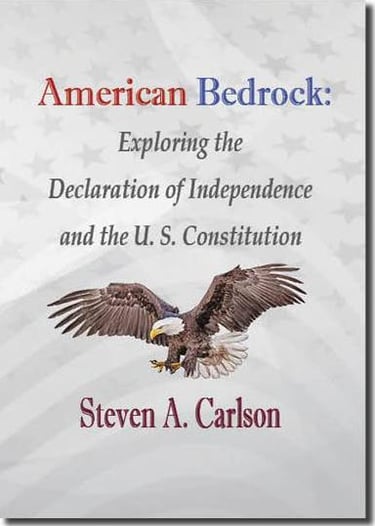
This book will truly enhance your understanding of the Declaration of Independence and the United States Constitution. Click the button below to check it out.
___________________________________________________________________________________________________________________________________________________________________________________________________


Contact
Questions? Reach out anytime.
Email:
contact@constitutionmatters.net
© 2025. All rights reserved.