Executive Orders, Mail-in Ballots, and the Constitution
A Matter of Internal Constitutional Conflict
Steven A Carlson
8 min read
To see a list of all commentaries, click the above picture.


Packing the Court - A Political Pipe Dream
Eliminate the Senate? Constitutional Folly


American Naiveté About Communism


Could D.C. Become the 51st State?
Understanding Executive Orders
Much has been made of President Trump's use of executive orders in his second term as president. It seems that almost every executive order issued by President Trump is met with legal challenges. At times those challenges are justified. Other times they are not. It might help, then, to get a sense of the purpose of executive orders and how they are to be used.
Generally speaking, an executive order is a tool available to the U.S. president to provide guidance to agencies and employees of the executive branch of the federal government. It is a mechanism by which the president can offer directions to members of the executive branch in order to carry out the political agenda of the administration. They are used to organize and manage the executive branch, set priorities, and coordinate activities across the various agencies under the president's charge, which includes most federal agencies.
There are occasions when an executive order may appear to exceed the limited scope of the executive branch. This can happen especially in times of national emergencies. However, as long as the order is deemed constitutional, it carries the same force and effect as a law passed by Congress and signed by the president. If the constitutionality of an order is challenged and it is ruled as unconstitutional by the courts, the order becomes null and void. This happened recently with President Trump's executive order denying birthright citizenship to the children of tourists and illegal aliens who are born on U.S. soil. The constitutionality of that order was challenged in court and the Supreme Court ruled that the order fell outside the scope of presidential authority.
While many executive orders are challenged by the political opposition, others go unchallenged and remain in effect. Indeed, several executive orders issued by President Trump are currently active. For instance, in 2025 President Trump issued executive orders to withdraw U.S. membership from the World Health Organization, do away with DEI hiring in the federal government, declassify government documents concerning the assassinations of President John F. Kennedy, Senator Robert F. Kennedy, and Reverend Dr. Martin Luther King, Jr., along with dozens of other executive orders.
Constitutional executive orders carry the weight of law, but they must also be considered temporary in nature. While a president can issue an executive order, that order can be undone by a future president. For instance, in 2024 President Biden issued an executive order forbidding the use of plastic straws, insisting that they be replaced with paper straws. President Trump reversed that executive order shortly after taking office in 2025.
The USPS and American Elections
On March 31, 2026, President Trump issued Executive Order 14399 regarding the United States Postal Service's handling of mail-in ballots during American elections. The idea behind the order was to secure the integrity of mail-in ballots given the weaknesses in the system that allow for fraudulent activity. Naturally, the constitutionality of the order has been challenged in court. How will the courts rule concerning Executive Order 14399? Legal experts have presented differing opinions.
There is a hefty constitutional argument to be made that the president's executive order exceeds his authority. In determining the processes for elections in the United States, the U.S. Constitution plainly places responsibility for elections squarely in the hands of the individual states with Congress participating in the passing of federal election laws when appropriate. Article I, Section 4, Clause 1 states:
The clause is pretty straightforward and, on the surface, seems to leave no wiggle room for the president's involvement in elections via an executive order. Consequently, it is not surprising that certain judges have ruled that Trump's executive order is, by its very nature, unconstitutional. It appears that he has no constitutional authority to interfere in a state's election operations.
The USPS: An Executive Branch Agency
While the Constitution does not provide the president with authority over elections, neither does a state have constitutional or statutory license to command the use of a federal agency in the processing of elections. The Post Office is an agency of the executive branch of the federal government and, as such, falls under the direct authority of the president of the United States. Certainly, the Post Office serves the public, including local and state governments and, without cause, there is no reason for the Post Office to disrupt those services. However, in this instance, there is more to consider.
What many may not know is that it is the president who is ultimately responsible for assuring that U.S. laws are upheld. According to Article II, Section 3 of the U.S. Constitution, the president must "...take care that the Laws be faithfully executed." Additionally, the Constitution, in Article II, Section 1, names the president commander in chief of the armed forces, thus assigning responsibility for national security. This includes maintaining the rule of law and ensuring that government actions are consistent with the Constitution. In the end, the president’s role is to uphold the constitutional order, which in turn supports the security and well‑being of the people.
Many are also unaware that it is unlawful to knowingly mail a ballot to someone who is not eligible to vote in American elections. Under 52 U.S.C. § 20511, it is a federal crime to knowingly submit or procure a ballot for someone who is not eligible to vote. This includes:
Attempting to vote, registering to vote, or voting
Aiding or abetting someone in doing so
Exercising other voting rights without eligibility
We no longer face the question of whether or not ineligible people vote in American elections. The recent revelations in New Jersey, where it was discovered that at least hundreds of ineligibles had voted, put that to rest. In fact, a recent federal review found that more than 250K ineligible individuals were registered to vote in just four states - California, New Jersey, Nevada, and Pennsylvania. Fact checkers insist that this number is vastly overstated, but no one argues that voter rolls are not seriously muddied with the registrations of ineligible voters. This, then, is where President Trump's executive order gains constitutional traction. Here are the issues to consider:
No state in the United States has the standing to demand that a federal agency (USPS) participate in an operation that is run by the state and falls under state jurisdiction, including elections.
Under 52 U.S.C. § 20511, it is a federal crime to knowingly submit or procure a ballot for someone who is not eligible to vote.
It is now undeniable that at least some states, through the use of the USPS, procure ballots for people who are ineligible to vote in American elections.
A state's use of the USPS to deliver ballots to ineligible voters requires the USPS to knowingly participate in a federal crime. The key word here is knowingly since there is no longer any doubt that a certain number of mailed ballots go to individuals who are ineligible to vote. It does not matter if it involves a few dozen ballots or several thousand ballots.
It seems reasonable that the president, who has responsibility for, and holds the position of authority over, postal operations, should have the prerogative, via executive order, to develop a method to assure that the USPS is serving the best interest of the United States. That would include preventing the delivery of ballots to individuals who are ineligible to vote. This is not only a reasonable conclusion but is the responsible course of action.
While Trump's executive order would not eliminate the issue of ballots being mailed to ineligible individuals, it would certainly help to minimize the problem.
Conclusion
The courts face an internal constitutional conflict. States are in charge of elections while the president presides over Post Office operations. As long as states seek the services of a federal agency in carrying out a state operation, the conflict remains. In this case, the states' authority over elections must be weighed against the president's authority with respect to federal agencies.
The ultimate fate of President Trump's executive order is unknown, but it will be decided in the near future. For now, it can be said that, constitutionally speaking, each side has the opportunity to deliver a reasonable argument supporting their position. However, for the following reasons, the president seems to be on rather solid footing in this case.
States have no constitutional or statutory standing to compel a federal agency to participate in a state-run operation. This is especially true since the use of in-person voting provides a means to carry out elections without engaging the Post Office.
The president has the constitutional responsibility to uphold federal laws and secure the well-being of the nation. While laws exist preventing the Post Office from being selective in whom it will service, this particular situation involves the transportation and delivery of illegal ballots - a factor that should be taken into consideration by the court. When it comes to participating in a crime, it stands to reason that the president has a constitutional duty to take preventative action.
Since upholding laws is a primary responsibility of the president, and since he is responsible for USPS operations, the court should not deny him the means to perform his constitutional duty.
The states have been offered, via executive order 14399, an opportunity for federal/state collaboration whereby the USPS can provide services in state-run elections without engaging in constitutional conflict.
These factors bode well for the president's position since they provide constitutional support for the executive order. Whether or not the administration will effectively articulate this legal rationale, and whether or not at least five justices on the Supreme Court will concur, remains to be seen.
The Times, Places and Manner of holding Elections for Senators and Representatives, shall be prescribed in each State by the Legislature thereof; but the Congress may at any time by Law make or alter such Regulations, except as to the Places of chusing Senators.
------------------------------------------------------------------------------If you enjoyed this article, please encourage your friends to visit us here at constitutionmatters.net where the Constitution really does matter. Also, if you appreciate the articles and insights provided here, feel free to contribute to the cause by clicking below.
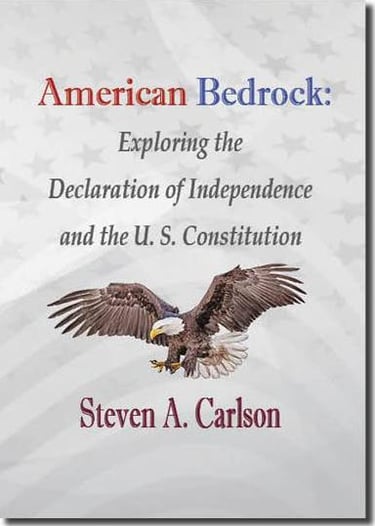
This book will truly enhance your understanding of the Declaration of Independence and the United States Constitution. Click the button below to check it out.

Contact
Questions? Reach out anytime.
Email:
contact@constitutionmatters.net
© 2025. All rights reserved.