
Federalist No. 3
National Strength Through a United Federal Government
Steven A. Carlson
4 min read
Insights - Federalist No. 3 - Concerning Dangers from Foreign Force and Influence (continued) Written by John Jay Independent Journal, November 3, 1787
Federalist No. 3, penned by John Jay, serves as a continuation of the perspectives he shared in Federalist No. 2, focusing on the safety and security of the United States. The argument he makes is that the union’s security remains sound in the hands of a national government as opposed to the isolated governments of thirteen individual states. In defense of his position on the matter, he discusses the issue of potential conflicts with other nations, stating:
The number of wars which have happened or will happen in the world will always be found to be in proportion to the number and weight of the causes, whether real or pretended, which provoke or invite them. If this remark be just, it becomes useful to inquire whether so many just causes of war are likely to be given by united America as by disunited America; for if it should turn out that United America will probably give the fewest, then it will follow that in this respect the Union tends most to preserve the people in a state of peace with other nations.[1]
John Jay’s position is that the handling of conflicts with other nations would be best left in the hands of a national government to protect the well-being of the union. His argument, which seems a reasonable one, is that a united front under a single, semi-powerful national government would more likely dissuade other nations from taking an adversarial disposition against the United States. Would another nation be more likely to invade a nation like the United States or, if given the opportunity, a smaller, more vulnerable realm such as Virginia or Pennsylvania? To John Jay, the answer was obvious.
Discussing the causes of war, Jay continues by offering samples of potential disputes between nations, explaining how those differences woud be handled far more resolutely if left in the hands of a single government speaking and acting on behalf of the numerous states.
John Jay continues his defense of welding together a national government by addressing the distinct advantages such a government could provide, particularly where the nation’s security was concerned. According to Jay, each state would need to develop its own government and its own security measures, including its own military, at least to some degree. However, in doing so, a state would be limited to installing officials, judges, and military officers from the limited supply available in that state. However, at the federal level, the best could be selected from a much larger field of candidates – the entire population of all the states combined.
The just causes of war, for the most part, arise either from violation of treaties or from direct violence. America has already formed treaties with no less than six foreign nations, and all of them, except Prussia, are maritime, and therefore able to annoy and injure us. She has also extensive commerce with Portugal, Spain, and Britain, and, with respect to the two latter, has, in addition, the circumstance of neighborhood to attend to. It is of high importance to the peace of America that she observe the laws of nations towards all these powers, and to me it appears evident that this will be more perfectly and punctually done by one national government than it could be either by thirteen separate States or by three or four distinct confederacies.[2]
But not only fewer just causes of war will be given by the national government, but it will also be more in their power to accommodate and settle them amicably.[4]
When once an efficient national government is established, the best men in the country will not only consent to serve, but also will generally be appointed to manage it; for, although town or country, or other contracted influence, may place men in State assemblies, or senates, or courts of justice, or executive departments, yet more general and extensive reputation for talents and other qualifications will be necessary to recommend men to offices under the national government, — especially as it will have the widest field for choice, and never experience that want of proper persons which is not uncommon in some of the States. Hence, it will result that the administration, the political counsels, and the judicial decisions of the national government will be more wise, systematical, and judicious than those of individual States, and consequently more satisfactory with respect to other nations, as well as more safe with respect to us.[3]
Many may argue, and perhaps rightly so, that Jay may have overstated his claim that “…the administration, the political counsels, and the judicial decisions of the national government will be more wise, systematical, and judicious than those of individual States.” It is easy enough to review the history of the nation and critique decisions made by the federal government that lacked the wisdom of which John Jay wrote. Still, his point is that, when it comes to dealing with other nations, a united front would place the United States in a much better position when it comes to defending the country.
In the end, John Jay’s point of the essay is that there are many matters that are more wisely left in the hands of the states. However, national defense and international relations are not among those matters best attended by a divided nation. In some of his closing words, he made the following weighty argument:
According to Jay, if the people of the United States wished to work amicably with other nations and avoid conflicts that could injure the nation, they should take his words to heart and ratify the Constitution. Such relations would be far more harmonious and less likely to cause conflict if such dealings were handled by a strong federal government working on behalf of the all individual states united under a single government.
________________________
[1] Federalist No. 3
[2] Ibid
[3] Ibid
[4] Ibid
------------------------------------------------------------------------------If you enjoyed this article, please encourage your friends to visit us here at constitutionmatters.net where the Constitution really does matter. Also, if you appreciate the articles and insights provided here, feel free to contribute to the cause by clicking below.
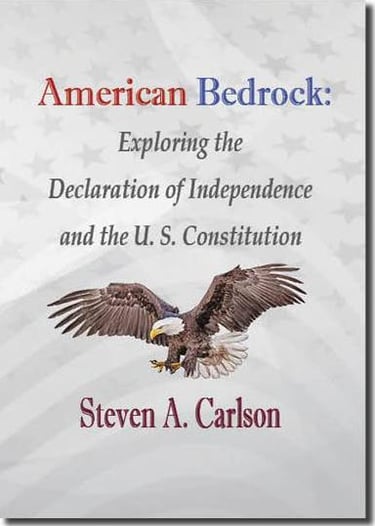
This book will truly enhance your understanding of the Declaration of Independence and the United States Constitution. Click the button below to check it out.
___________________________________________________________________________________________________________________________________________________________________________________________________


Feel free to visit restoretheword.com
Contact
Questions? Reach out anytime.
Email:
contact@constitutionmatters.net
© 2025. All rights reserved.