
The 2020 Election...By the Numbers
A Statistical Analysis of the 2020 Presidential Election
Steven A. Carlson
7 min read
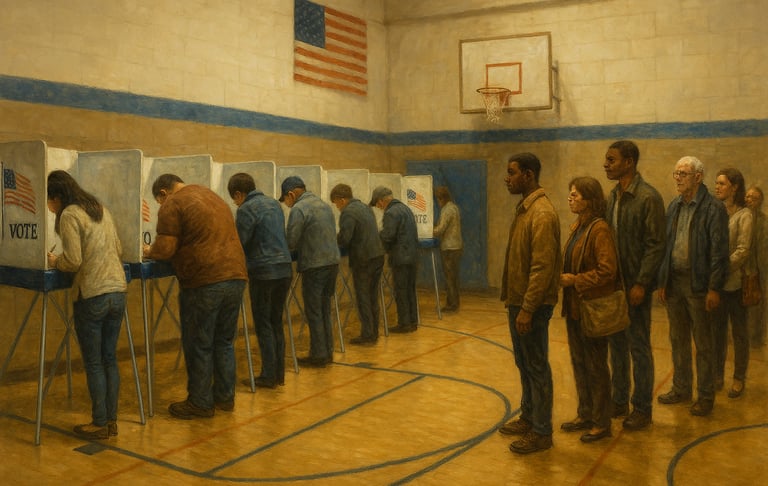
When someone questions the outcome of the 2020 presidential election between Joe Biden and Donald Trump, a common response of those on the left is a wry sneer. That sneer is not intended as a smirk of admission that Biden won through underhanded means. Rather, it is a subtle swipe at the sheer ignorance of anyone who would doubt the integrity of the most error-free election in the history of our nation (so we have been told). The following statistics (of which most people are unaware) are offered, not to litigate that election, but to provide insight into the commonsense legitimacy of the concerns that have been raised.
1. Donald Trump won Florida by 3.3% and he won Ohio by more than 8% in 2020. Historically, the only time a candidate has won both Florida and Ohio and still lost the election was in 1960 when John Kennedy defeated Richard Nixon. In retrospect, many have pointed to highly questionable results in Illinois (which Kennedy won by 8,858 votes) and Texas (where Kennedy won by 46,257 votes) to give him the necessary electoral votes. Still, in the last 60 years, no one has won the presidency without winning either Florida or Ohio.
2. No candidate has ever won 75% of his party’s primary vote and lost in the general election. Donald Trump received well over 90% of the Republican primary votes in 2020.
3. In 2020, Donald Trump substantially increased his percentages among minorities and women when compared with 2016. Yet, among his strongest constituency (white men), he purportedly lost enough ground to lose in 2020. This is especially curious since the white male vote only showed an 11% increase over 2016 while the total popular vote increased by roughly 28%. Trump’s strongest constituency showed a substantially lower increase than other demographics. Additionally, according to the numbers, there was an 8% shift among white males from Trump to Biden in 2020. The plan here was to compare Trump’s white male primary votes between 2016 and 2020 but that data seems to be unavailable. That may be because Trump was virtually unopposed in 2020. Consequently, the data would likely be meaningless since some states did not hold a Republican presidential primary that year. For instance, Arizona held no Republican presidential primary in 2020. However, among Wisconsin, Michigan, Pennsylvania, and Georgia, all Democrat presidential candidates together received a total of 4.8 million votes while Donald Trump received 3.25 million votes even though no one really needed to come out and vote for him. The number probably reflects those who were interested in voting in the state and local primaries in those states.
4. In 2008, Barack Obama won a total of 875 U.S. counties while John McCain won 2,238 counties. However, Obama’s counties were more populous (New York, Los Angeles, Chicago, etc.), and he won the popular vote 69 million to 59 million. In 2012, Barack Obama won only 689 counties (down 186 from 2008) while Mitt Romney won 2,424 counties. That year Obama won the popular vote 66 million to 61 million. Hillary Clinton won only 487 counties in 2016, although her total vote count was 66 million. Donald Trump won 2,626 counties that year and received 63 million votes.
In 2020, Joe Biden won a total of 477 counties (the lowest in 50-state history at the time) compared to Donald Trump’s 2,636 counties, yet Biden purportedly received 81 million votes while winning only 54.5% of the counties that Barack Obama won in 2008 (a roughly 22% increase…a feat dwarfed by Thomas Jefferson’s 133% increase in 1804 and matched by Franklin Roosevelt, a most popular president in, 1936). It is to be believed, then, that Joe Biden garnered 15 million more votes in 2020 than Barack Obama received in 2012 while winning 212 fewer counties. In 2024, Donald Trump flipped an additional 54 counties from blue to red, giving him 2,690 counties compared with Kamala Harris’s 423 counties.
Although Hillary Clinton won 202 fewer counties in 2016 than Barack Obama won in 2012, she was still able to match the 66 million votes received by Barack Obama in 2012. However, she was unable to increase that popular vote with fewer county wins. The pattern is clear. Each time a Democrat candidate won fewer counties than the previous election, their popular vote either dropped or remained the same. Yet, somehow Joe Biden was able to increase the Democrat vote substantially while winning the fewest counties ever recorded in history in a 50-state nation by someone who was not a third-party candidate. That outcome is curious at best.
5. In the U.S. there are 19 counties that are considered bellwether counties. That is to say, whoever wins those counties (since 1980) wins the presidency. They are Bremer County in Iowa, Clallam County in Washington, Cortland County in New York, Essex County in Vermont, Hidalgo County in New Mexico, Juneau County in Wisconsin, Marquette County in Wisconsin, Otsego County in New York, Ottawa County in Ohio, Richland County in Wisconsin, Sawyer County in Wisconsin, Shiawassee County in Michigan, Valencia County in New Mexico, Van Buren County in Michigan, Vigo County in Indiana, Warren County in Illinois, Washington County in Maine, Westmoreland County in Virginia, and Wood County in Ohio,
In 2020, Trump won 18 of those counties and he won them by an average of roughly 14%. Only Clallam County voted in favor of Joe Biden. In particular, Trump won Valencia County in New Mexico – a county that has selected the winning candidate every year since 1952. This was repeated in 2024 with Trump again winning 18 of these bellwether counties accompanied by a Trump win of the popular vote in the United States.
6. Consistently, Donald Trump had tens of thousands of supporters at his rallies even when they received late notice about the rally. Biden, on the other hand, appears to have spent much of the campaign in his basement and had trouble getting more than a few dozen people to a political rally. This one speaks for itself.
7. In the early stages of the United States, as the population grew exponentially, it was not unusual for an incumbent to increase his vote count from his first run for the office. Only two incumbent Presidents have actually increased their popular vote and ended up losing the election. In 1828, John Quincy Adams increased his vote substantially, but lost to Andrew Jackson. That is a bit deceiving, however, since Adams had lost the popular vote to Jackson four years earlier. While Jackson had earned more electoral votes in 1824, Adams was awarded the presidency by Congress due to the failure of any candidate to reach a majority of electoral votes.
In 1884, Grover Cleveland won the presidency with 4.9 million votes. However, in 1888 he lost to Benjamin Harrison even though Cleveland garnered 5.35 million votes (a 9% increase) to Harrison’s 5.44 million. Interestingly, Cleveland regained the presidency in 1892.
It is not possible to compare Gerald Ford’s 1976 numbers since he was not elected in 1972; however, Herbert Hoover (1932), Jimmy Carter (1980), and George H. W. Bush (1992) all dropped millions of votes in their second bid for the office. In fact, Obama lost nearly 4 million votes in his second bid and still won the presidency. Consequently, Trump would be the third sitting president, and the only one in the last 132 years, to gain votes and still lose a second term. That is especially suspect since he increased his popular vote by roughly 11 million (a more than 17% increase) as opposed to Grover Cleveland’s 9% increase. With the exception of the 1828 John Quincy Adams loss, (an election involving unusual circumstances), Trump is the only incumbent to increase his popular vote by more than 15% and still lose the election.
There are undoubtedly other relevant stats showing comparable data, but these are sufficient to make the point. While many insist that the 2020 presidential election was error-free – a claim that has since been adequately debunked in places like Fulton County, Georgia and the recently exposed motor-voter issues in Pennsylvania – these statistics offer ample grounds for questioning what occurred during that election. Given these numbers, it seems that voicing those concerns warrants a more dignified response than a dismissive sneer. It is safe to say that, had Joe Biden lost the 2020 election with these kinds of numbers favoring him, the reaction from his supporters would have been far more unsettling than the events of January 6, 2021.


To see a list of all commentaries, click the above picture.






Policy v Politics
Socialism v Fascism
Free Speech - Rights and Responsibilities
Navigating the 2nd Amendment
See below for contact information


This book will truly enhance your understanding of the Declaration of Independence and the United States Constitution. Click the button below to check it out.
___________________________________________________________________________________________________________________________________________________________________________________________________


Contact
Questions? Reach out anytime.
Email:
contact@constitutionmatters.net
© 2025. All rights reserved.