Birthright Citizenship and a Typhlotic Courtroom Lesson 5: 20th Century U.S. Citizenship
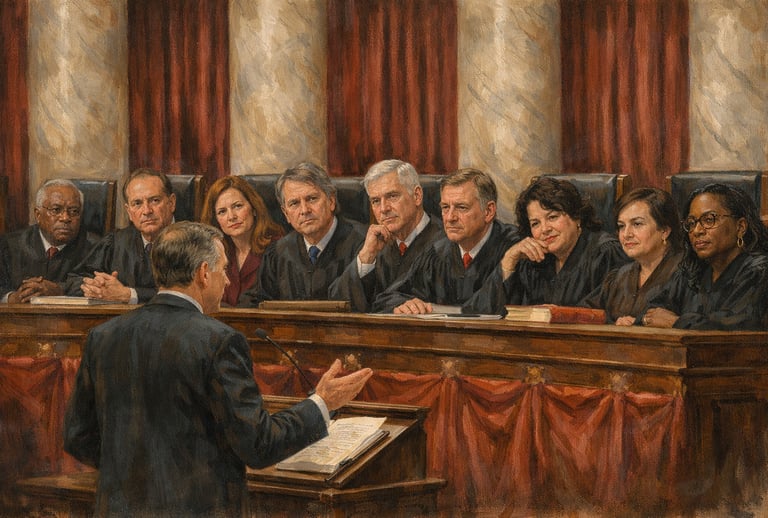
A disturbing case of the blind leading the blind
Steven A. Carlson
7 min read

To see a list of all commentaries, click the above picture.
Birthright Citizenship and a Typhlotic Courtroom - Lesson 1: Esrly U.S. Citizenship
Birthright Citizenship and a Typhlotic Courtroom - Lesson 2: The 14th Amendment
Birthright Citizenship and a Typhlotic Courtroom - Lesson 3: The Reconstruction Era
Birthright Citizenship and a Typhlotic Courtroom - Lesson 4: Wong Kim Ark
Dear Visitor:
Thank you for your interest in constitutionmatters.net. Please be advised that in order to fully appreciate this commentary, it would be wise to first read Lessons 1 - 4 of this series. Those lessons provide valuable foundational support for what you will read here. They can be found under Constitution Commentaries or Commentaries Alphabetical Listing in the menu at the top of the page.
The Naturalization Act of 1906
Thus far in this series of articles on birthright citizenship, the claim has been echoed again and again that ratification of the 14th Amendment was not intended to, and did not, impact the foundational Naturalization Act of 1802. For the entire 19th century, this statute was primary where the U.S. citizenship of foreigners was concerned. The 14th Amendment states that: “All persons born or naturalized in the United States, and subject to the jurisdiction thereof, are citizens of the United States…” Despite the admitted peculiarity of the language, it was recognized both by the courts and the general public that the 13th, 14th, and 15th Amendments, adopted during Reconstruction, were designed solely as a matter of addressing the freedom, citizenship, rights, privileges, and protections of former slaves.
That the 1802 statute was in effect and primary for the entire century was confirmed in 1906 with the passage of the Naturalization Act of 1906. This statute served to Establish a Bureau of Immigration and Naturalization, and to provide for a uniform rule for the naturalization of aliens throughout the United States. This was the first law passed in more than a century that addressed general immigration in the United States, thus superseding the 1802 statute. The goal was to centralize naturalization rather than placing upon the shoulders of perhaps 5,000 courtrooms across the country the responsibility of developing their own specific rules of naturalization.
President Theodore Roosevelt signed the statute into law on June 29, 1906. While the citizenry had grown substantially during the 19th century, naturalization was chaotic. The procedures in one state differed from those of another state. Indeed, the rules and forms required for naturalization often differed from courtroom to courtroom. The goal in 1906 was to standardize the procedures of naturalization across the whole of the country. Key provisions of the 1906 statute included:
------------------------------------------------------------------------------If you enjoyed this article, please encourage your friends to visit us here at constitutionmatters.net where the Constitution really does matter. Also, if you appreciate the articles and insights provided here, feel free to contribute to the cause by clicking below.
1. The establishment of the Bureau of Immigration and Naturalization inside the Dept. of Commerce and Labor.
2. Aliens seeking U.S. citizenship were required to be able to speak English. Exceptions were, of course, made for anyone physically unable to comply.
3. Seemingly contrary to the Supreme Court decision in United States v Wong King Ark, which insisted that the term “All persons” in the 14th Amendment was universal, this 1906 act limited citizenship to “free white persons” and “aliens of African nativity and persons of African descent. Contrary to the Wong Kim Ark decision, Asians were specifically excluded.
4. The act also introduced provisions for denaturalization, allowing the government to cancel the citizenship of anyone who had attained that citizenship through fraudulent means.
1. The legislation expanded the list of undesirables who would be refused entry into the country. This list included imbeciles, feeble-minded individuals, those with physical/mental disabilities that prevented them from working as a matter of contributing to society, victims of disease like tuberculosis, people who had committed crimes, and children without parents. Many may cringe at some of these words, but it was the language of the day.
2. The “head tax” (a fee charged to each immigrant entering the country) was raised from $2 to $4. This tax started at $.50/person in the Immigration of 1882 and was raised to $2 in 1903.
The Immigration Act of 1907
The following year, Congress passed what is known as The Immigration Act of 1907. Immigration acts do not necessarily impact naturalization, but they do provide a sense of national concerns. The act was passed as a matter of limiting U.S. immigration based on the concept of Nativism (the belief that the interest of the current U.S. citizenry should be given priority over immigrants). This act provided the following more restrictive changes in immigration policy.
Other 20th Century Immigration Laws
The Immigration Act of 1921 (Emergency Quota Act) established immigration quotas. Each country was limited to 3% of its number of immigrants in the U.S. as of the 1910 census. The statue also set a limit of roughly 350,000 immigrants per year.
The Immigration Act of 1924 (The Johnson Reed Act) was even more restrictive. The quota per country was reduced to 2% of the country’s number of immigrants in the U.S. at the time of the 1890 census. It also required immigrants to obtain a visa from U.S. Consulates abroad before entering the U.S. This act also established the U.S. Border Patrol.
The Great Depression of the 1930’s and WWII in the 1940’s reduced immigration numbers considerably. Surprisingly, in 1943, and in the midst of the war, Congress passed the Immigration Act of 1943. This act repealed all previous Chinese exclusions and allowed Chinese immigrants access to citizenship through naturalization.
After the war ended, adjustments were required. For instance, some soldiers had married foreign women overseas. Consequently, in 1945, Congress passed The War Brides Act. At the time a quota system was still in place, but this act allowed the foreign wives of soldiers, along with their children, to circumvent that quota system.
The current immigration and naturalization rules for the United States date back primarily to 1952 when Congress passed the Immigration and Nationality Act of 1952 (the Walter-McCarran Act). The statute was massive and covered pretty much every aspect of immigration and naturalization in the U.S. It was written at a time when concerns over the infiltration of Communism were at a peak and the Cold War heavily impacted Congressional priorities. As such, the act prohibited the admission of members of the Communist Party and other totalitarian regimes. The quota system was maintained under the statute, heavily favoring individuals from Northern and Western Europe.
The Immigration and Nationality Act of 1965 (The Hart-Celler Act), amended certain policies contained in the 1952 statute. For instance, the national origins quota system was undone. Additionally, the statute offered leniency in matters of family unification but, at the same time, tightened rules regarding visas for professionals and laborers.
There are of course, a host of legislative activity not mentioned here. For instance, The Immigration and Nationality Acts of 1976 and 1978 raised the per country limits for countries in the Western Hemisphere and the Immigration Act of 1990 introduced the H-1B visa program, but these are of little consequence in the big picture. What this article offers is a glimpse into the history of immigration and naturalization over the course of the 20th century in an effort to simply familiarize the readers with that history.
A number of court cases throughout the 20th century relied on the 14th Amendment, but those cases involved matters like same-sex marriage, interracial marriage, due process, etc. Of course, none of those cases are even closely related to the original intent of the amendment, but that is water under the bridge at this point. What is relevant is the upcoming SCOTUS decision that will purportedly be derived based on the oral arguments presented to the Court on April 1, 2026.
This series on childbirth citizenship will conclude with Lesson 6, which will appear on this website on Monday, May 18, 2026. At that time, the focus will be on the case currently being considered by the Supreme Court as oral arguments were heard on April 1, 2026. Everything up to this point has been offered to give you the reader the background information necessary to be able to consider evenhandedly the current issues before the Court. I anticipate your return here at constitutionmatters.net for that final lesson.
End Lesson 5
1. Immigrants were subjected to a literacy test.
2. Immigration from much of the Middle East and Asia was banned.
3. This list of those banned from entry grew substantially. Without naming them all, suffice it to say that the list grew to include idiots, paupers, political radicals, the insane, and a host of others.
4. The act did allow permits for temporary laborers to enter the country for work purposes.
This list of changes is hardly comprehensive. The objective is simply to highlight certain minor modifications that took place in the early stages of the 20th century.
The Immigration Act of 1917
The Immigration Act of 1917, also referred to as The Burnett Act, reflected a strong sense of nativism in America. The act introduced changes to immigration policies reflecting concerns over the impact of immigration on American society generally. For this reason, in the early 20th century, each time a new immigration law was introduced it seemed to be more restrictive than previous laws. This act saw the following changes to immigration law:
This book will truly enhance your understanding of the Declaration of Independence and the United States Constitution. Click the button below to check it out.
___________________________________________________________________________________________________________________________________________________________________________________________________


Contact
Questions? Reach out anytime.
Email:
contact@constitutionmatters.net
© 2025. All rights reserved.