
Birthright Citizenship and a Typhlotic Courtroom Lesson 1: Early U.S. Citizenship
A disturbing case of the blind leading the blind
BLOG
Steven A. Carlson
7 min read


To see a list of all commentaries, click the above picture.

Legal v Constitutional - Part 1
Legal v Constitutional - Part 2


Who Will Be the Next Eric Swalwell?
Men in Women's Sports and More
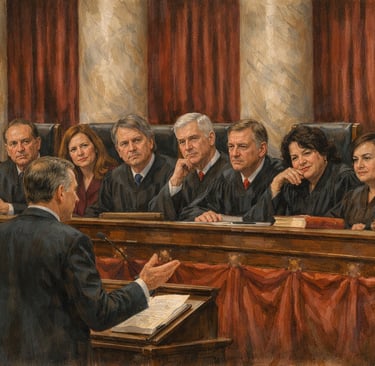


Typhlotic: the Meaning
Many may be wondering what the word typhlotic means. In fact, it may well be this very word that caught your attention and brought you to this sight. Nonetheless, I appreciate that you are here. The word derives from typhlosis which generally means sightless. According to thesaurus.com, typhlotic speaks of being unseeing, undiscerning, destitute of vision, etc. You get the idea. As you continue reading, that meaning will make sense.
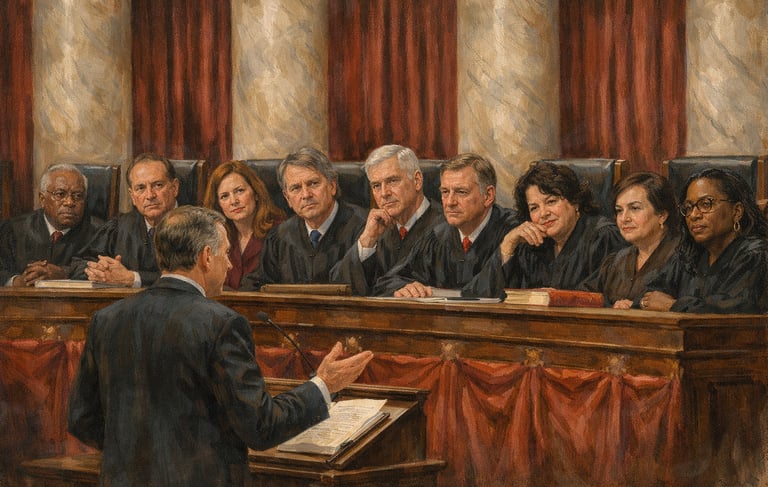
This 6-part series of articles will review the oral arguments presented to the Supreme Court on April 1, 2026, regarding birthright citizenship and the 14th Amendment. From a personal perspective, it seems both the arguments presented by the DOJ and most of the questions from the justices missed the point. It is as if no one in the room had read any of the history of U.S. citizenship that took place prior to 1898, but that history is at least as important as anything discussed in that room on April 1st. In order to provide perspective regarding those oral arguments, you will find here a deep review of U.S. citizenship dating back to the earliest days of the union.
Citizenship in the Early United States
U.S. citizenship was loosely defined and even quite subjective prior to the ratification of the Constitution. For instance, immigrants who had fought on the side of the colonies in the Revolutionary War were generally considered citizens along with those who, in some fashion, had shown their allegiance to the United States. Prior to the Constitution, a person’s citizenship, or lack thereof, was decided at the state level and was often determined in the courts.
Citizenship was mentioned on occasion in the Articles of the Constitution (i.e., Article I, Section 2, Clause 2; Article II, Section 1, Clause 5; Article III, Section 2, Clause 1; Article IV, Section 2, Clause 1). Complementing the use of this term in the Articles, U.S. citizenship is also referenced in the 11th Amendment. The inescapable conclusion drawn from the uses of this term is that the Founding Fathers presumed the existence of citizenship at both the state and federal levels in the United States of America. However, while citizenship was recognized by those men, it was never clearly defined.
In the days following ratification of the Constitution, the idea of citizenship at both the state and federal levels was widely discussed. Citizenship was important since the Constitution recognized certain rights, privileges, and protections afforded the citizenry at each level. The Constitution had placed upon Congress the responsibility for developing a process for naturalization (Article I, Section 8, Clause 4).
In the early stages of George Washington’s Presidency, Congress devised a system of citizenship in The Naturalization Act of 1790. However, at the time slavery was still a common practice and foreigners (especially those who were not White Caucasian) were viewed with skepticism. Thus, the naturalization process was limited to “…any alien, being a free white person, who shall have resided within the limits and under the jurisdiction of the United States for the term of two years.”[1] The following is a description of the naturalization processes established in that act.
That any alien, being a free white person, who shall have resided within the limits and under the jurisdiction of the United States for the term of two years, may be admitted to become a citizen thereof, on application to any common law court of record, in any one of the states wherein he shall have resided for the term of one year at least, and making proof to the satisfaction of such court, that he is a person of good character, and taking the oath or affirmation prescribed by law, to 'support the constitution of the United States,’ which oath or affirmation such court shall administer; and the clerk of such court shall record such application, and the proceedings thereon; and thereupon such person shall be considered as a citizen of the United States. And the children of such persons so naturalized, dwelling within the United States, being under the age of twenty-one years at the time of such naturalization, shall also be considered as citizens of the United States. And the children of citizens of the United States, that may be born beyond sea, or out of the limits of the United States, shall be considered as natural born citizens: Provided, That the right of citizenship shall not descend to persons whose fathers have never been resident in the United States: Provided also, That no person heretofore proscribed by any state, shall be admitted a citizen as aforesaid, except by an act of the legislature of the state in which such person was proscribed,(«) APPROVED, March 26, 1790.
In the earliest days of the Union, citizenship was male-centered. While the term “all persons” in The Naturalization Act of 1790 included women, the law also stated that “the right of citizenship shall not descend to persons whose fathers have never been resident in the United States....” Thus, even if the mother was an American citizen, a child born abroad whose father had not resided in the United States was not automatically granted citizenship. Until 1934, when Congress corrected this evident inequity, a person’s descendant citizenship was realized solely through the father.
While it was a decent start at developing a naturalization process in the U.S., the statute did not deal with many forthcoming issues where citizenship was concerned. Consequently, The Naturalization Act of 1790 was repealed and replace by The Naturalization Act of 1795. In this new rendition, certain changes were made including the following:
1. The Naturalization Act of 1790 required U.S. residency of at least two years prior to applying for citizenship. The Naturalization Act of 1795 expanded the residency requirement to five years, but also mandated that a declaration of a person’s intent to apply for citizenship must be made to the court at least three years prior to submitting a citizenship application.
2. The Naturalization Act of 1790 required the taking of an oath by the applicant to support the U.S. Constitution. The Naturalization Act of 1795 not only required such an oath, but made mandatory a renunciation of all allegiances to any and all foreign entities.
In the late 1700’s, foreigners generally entered the U.S. with a political perspective that echoed that of the Democrat-Republicans – the conservative party of Thomas Jefferson and James Madison. However, with John Adams, a Federalist, in the presidency and his party controlling the legislature, it was decided that more stringent citizenship requirements should be established. Consequently, changes were made in The Naturalization Act of 1798, including the following:
1. A person must have resided in the United States at least fourteen years and resided in the state of application for at least five years prior to applying for citizenship.
2. Additionally, the applicant must make a declaration of intent to apply for citizenship no less than five years prior to submitting said application.
The Naturalization Act of 1802 was enacted by the 7th United States Congress and signed into law by President Thomas Jefferson on April 14, 1802. This legislation repealed the restrictive Naturalization Act of 1798, which had been a source of political controversy. The new act restored the less prohibitive naturalization standards that had been in place under the 1795 law. The primary effect was significantly reducing the required residency period for applicants seeking naturalization.
This act reduced the residency requirement for aliens from fourteen years to five years and the Declaration of Intention notice from five years to three years. As before, youth who were under the age of twenty-one who were children of naturalized citizens were also recognized as citizens.
Through the first several decades of the 19th century a variety of citizenship statutes were passed by Congress, though many of those laws dealt with technical procedural matters rather than conditions of citizenship.
1. The Act of 1813 required continuous residency prior to naturalization.
2. The Act of 1823 revised and simplified a number of naturalization registry requirements.
3. The Naturalization Act of 1855 recognized as a citizen any woman who married a man who was an American citizen.
Through all of these several laws, black slaves were never recognized as citizens. Enter: Dred Scott v Sandford. In 1857 a court case reached the Supreme Court dealing with the citizenship of slaves. The suit was brought by a slave by the name of Dred Scott. In the case, which spent years in the lower courts, Mr. Scott sought to claim his freedom – a case which he lost. This article will not delve into the specifics, but readers are encouraged to check it out. Suffice it to say that the Court’s ruling in Dred Scott, and particularly Justice Taney’s majority opinion, represents a low point in the history of the Supreme Court of the United States.
The early naturalization laws mentioned here in Lesson 1 are consequential where birthright citizenship is concerned. While some of the general principles such as allegiance were referenced, the applicability of these laws during the Reconstruction (Post Civil War) Period was surprisingly lacking in the oral arguments given before the Supreme Court in April.
Lesson 2, which will arrive on this website on Monday, May 4th, will explore the Civil War era, taking a look at laws passed during and after the war. Also, certain constitutional amendments passed by Congress and ratified by the states in the Post-Civil War era will be examined, offering significant insight into the topic of birthright citizenship, so please stay tuned over the coming days here at constitutionmatters.net.
End Lesson 1
[1]Immigration History, Nationality Act of 1790, https://immigrationhistory.org /item/1790-nationality-act/, Accessed April 15, 2026.
------------------------------------------------------------------------------If you enjoyed this article, please encourage your friends to visit us here at constitutionmatters.net where the Constitution really does matter.
See below for contact information
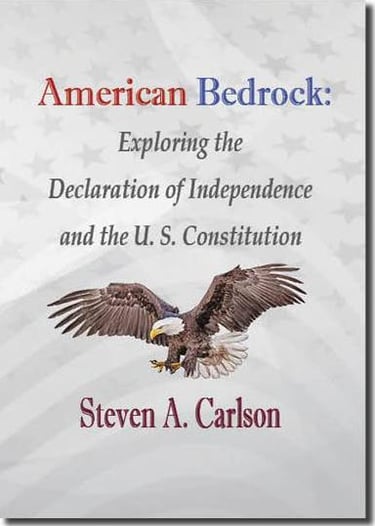
This book will truly enhance your understanding of the Declaration of Independence and the United States Constitution. Click the button below to check it out.
___________________________________________________________________________________________________________________________________________________________________________________________________


Contact
Questions? Reach out anytime.
Email:
contact@constitutionmatters.net
© 2025. All rights reserved.