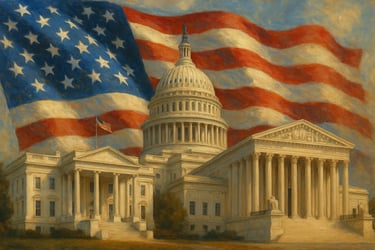
Incoming Political Storm: The 2030 census - Part 1
Considering how the 2030 census will impact American politics
Steven A. Carlson
6 min read


Separation of Church and State - Part 2

Being a Constitutionalist
Word Play and Political Demagoguery

To see a list of all commentaries, click the above picture.
Recalibrating the Census
Article I, Section 2 of the U.S. Constitution calls for a census of the U.S. population to be undertaken every ten years. The rationale for this are varied, but one of the primary reasons for the census is to assure that the population of each state is represented equitably at the federal level. This is particularly true when it comes to: 1) representation in the House of Representatives and 2) representation in the Electoral College. The census is also a factor when it comes to deciding how hundreds of billions of dollars in federal assistance will be allocated over the coming years.
The next scheduled census will take place in the year 2030. Planning is underway, and has been for a while, as preparations are made to assure an accurate count of the number and location of the United States population. What is interesting, and what most people do not know, is that there will be what is termed a recalibration of the census in 2030. Exactly what does recalibration mean and how will it impact the results of the 2030 census?
Recalibration basically refers to significant changes in the manner of data collection. The census is conducted by the Census Bureau and this organization has been working on a recalibration plan since 2019. As of July 2025, the Bureau had developed plans involving several changes for the 2030 census. These changes include discontinuing the nationwide canvassing that has been used historically to build an address list, expanding its use of data from other government agencies to include those who fail to respond to the census, and reducing field-office groundwork. The hope is that these steps will improve accuracy while reducing the costs involved in gathering the data.
The demographics within the borders of the United States have evolved over time. Recalibration is intended to improve data collection by incorporating new technologies such as online surveys or data analytics. The hope is that these strategies will reach a broader audience compared to traditional methods. There are also plans in place to bolster outreach campaigns in communities that have historically been underrepresented, hopefully ensuring that these populations are counted accurately.
The motivations behind recalibration of the census stem from 1) the need to improve accuracy and 2) cost reduction. Reports say that the costs of the census rose from $45/household in 1990 to $99/household in 2020. Given that there are an estimated 135 million households in the United States, the cost of conducting the census is no small matter. Additionally, the Bureau undoubtedly receives abundant input and suggestions from the legislative and executive branches as well as from the various states who seek desperately to avoid underrepresentation.
It seems reasonable to believe that a census should take on an apolitical persona. However, as has become clear over the past few decades, in the United States there is no such thing as apolitical. Consequently, the recalibration process is not without its challenges and controversies. Different parties (often politically motivated) have varying takes on what constitutes accurate representation. For instance, there is concern that these recalibrated methods may end up unintentionally favoring a specific political agenda. As a matter of political unease, critics of these new methods may well raise concerns about the trustworthiness of these new methodologies, questioning whether they might lead to discrepancies in the data collected. Thus, while the recalibration of the census aims to address issues of data accuracy and representation, it also raises significant questions about political implications and the integrity of the electoral system.
2030 Factors Impacting Politics
Over the past few years, the U.S. population has been on the move. It seems certain states have experienced an exodus while other states have seen a measure of population growth. There are assorted reasons for that movement, but many anticipate that this could play a major role in the outcome of the 2030 census. While it is extremely difficult to accurately estimate the 2030 population by state, there have been significant indicators that suggest certain trends.
It is estimated that the total population of the United States grew from 331 million in 2020 to roughly 343.6 million in 2025, a roughly 3.5% increase. However, that growth was not evenly distributed from coast to coast. Certain states saw a considerable increase in population while other states actually saw their numbers decline.
Of the ten largest states in the union, Texas and Florida saw substantial growth. Texas’ population jumped from 29,149,498 to an estimated 31,709,521, or 8.78%. Meanwhile, over that same stretch, Florida saw its population go from 21,538,207 to an estimated 23,462,518, which is an increase of 8.93%. Other large states that experienced increases in population include North Carolina (7.25%), Georgia (5.50%), Ohio (0.85%, Michigan (0.48%), and Pennsylvania (0.44%).
Of those ten largest states, only three saw a decline in population. New York dropped from a population of 20,203,696 in 2020 to an estimated 20,002,427 in 2025, or -1.0% of its residents. California went from 39,555,703 in 2020 to an estimated 39,355,309, which is a decline of -0.5%, and Illinois saw its population go from 12,821,741 to 12.719.141, or -0.8%.
While they have smaller populations, certain other states have also shown growth of more than 3% over this five-year stretch. This includes Idaho (8.2%), S. Carolina (6.3%), Utah (6.7%), Delaware (6.0%), Arizona (5.5%), Nevada (4.8%), Montana (4.6%), Tennessee (4.3%), S. Dakota (4.1%), Oklahoma (3.3%), and Washington (3.0%). There were only three other states that witnessed a population decline. They were Louisiana (-1.2%), Mississippi (-0.5%), and Hawaii (-0.4%),
If you think you see a trend in these population shifts, it’s because there is a trend, and it is significant. With the exceptions of Delaware, every state that experienced population growth is a state that voted for Donald Trump in 2024. Also, with the exceptions of Louisiana and Mississippi, every state that declined in population voted for Kamala Harris in 2024. However, the implication of these numbers goes beyond those two simple statistics. What is most significant is not how each state voted in a single election, but how they have voted over the long-term. States like Texas, Florida, Idaho, Utah, and others who have seen the healthiest growth in population have a solid history of voting for Republican candidates. The same is true of other states not listed – states like Alabama, Kansas, and Wyoming – who saw their populations rise.
If these trends continue, and there is reason to believe they will, Florida and Texas could each show an increase in population from 2020 to 2030 of as much as 18%. Other conservative states like Idaho, S. Carolina, and Utah could also see double-digit increases. At the same time, states like California, Illinois, and New York look like their populations will either remain stagnant or continue to fall slightly. Considering the departures that have begun over the past few months, the better bet is that their populations will fall – perhaps dramatically.
There is one additional factor that may well impact the political makeup of America when the census is completed. Donald Trump is insisting that illegal immigrants be omitted from the census. His argument is that the Constitution calls for Washington to represent the citizens of the United States. In fact, he is asking that a new census be carried out immediately to adjust representation to accurately reflect the number of citizens in each state. If this were to happen, those states having the most illegal immigrants, who are interestingly many of the same states experiencing a significant decline in population, could lose even more representation and more electoral votes. Thus, the shift in the House of Representatives and Electoral College could be even greater than anticipated.
Part 2 of this essay will get into the weeds of exactly how the movement of the electorate will impact upcoming elections in the House of Representatives and even in the presidency. The impact will, in fact, be dramatic as the United States can anticipate a considerable shift to the political right where representation in Washington is concerned. Hope to see you there.
End Part 1

Word Play and Political Demagoguery
See below for contact information


This book will truly enhance your understanding of the Declaration of Independence and the United States Constitution. Click the button below to check it out.
___________________________________________________________________________________________________________________________________________________________________________________________________


Contact
Questions? Reach out anytime.
Email:
contact@constitutionmatters.net
© 2025. All rights reserved.