
Legal v Constitutional - Part 1
When the law fails to conform with constitutional principles
BLOG
Steven A. Carlson
3 min read

To see a list of all commentaries, click the above picture.


Concerning California's Wealth Tax Proposal - Part 2
Concerning California's Wealth Tax Proposal - Part 3

Understanding Individual Rights


Who Will Be the Next Eric Swalwell?
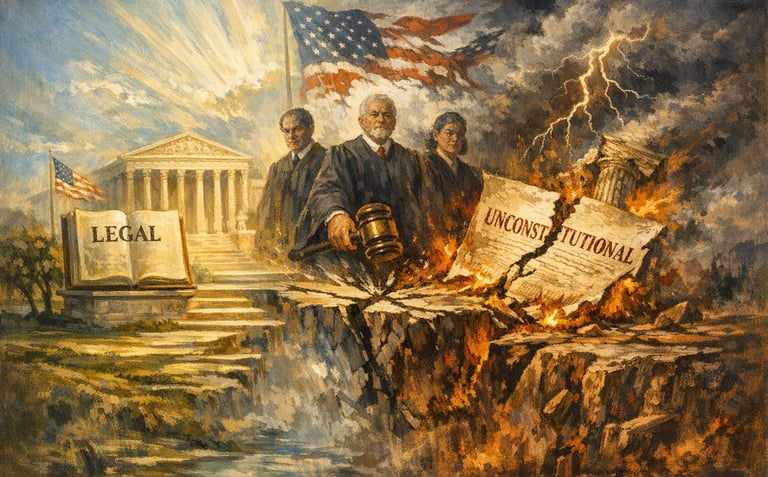
Legal v. Constitutional
This heading may invite some raised eyebrows, but it is a legitimate topic for consideration. Contrary to what many people may think, the Constitution of the United States is not intended to be the law of the land, at least, not in a statutory sense. This is made clear within the Constitution itself when, in Article III, Section 2, while discussing judicial authority, a clear distinction is drawn between “…this Constitution, the Laws of the United States, and Treaties made.” Article VI, Clause 2, casually combines the Constitution with laws and treaties, calling them “the supreme Law of the Land,” but that language was used as the founders weighed the supremacy of the U. S. Constitution and federal laws against the authority of state constitutions and state laws.
The distinction between legal and constitutional frameworks is essential for understanding how governance operates within a society. Legal systems are comprised of the rules and regulations enacted by governmental bodies, which govern the behavior of individuals and organizations. These laws are crafted through various legislative processes and can vary widely across jurisdictions. They can be amended or repealed, reflecting the changing needs and challenges faced by a society.
On the other hand, constitutional principles represent the foundational ideals and values upon which a nation is built. The constitution serves as a guide for the creation and enforcement of legal statutes. It lays out the fundamental rights and liberties of individuals, outlining the responsibilities of government institutions and protecting citizens from abuse of power. In essence, while laws can be reformulated, constitutional principles remain more static and foundational.
The Constitution is the founding document that establishes the form of the United States government, but it does not create laws. Amendments generally address individual rights or issues pertaining to the operation of the government. The single constitutional amendment that appeared to take statutory form was the Eighteenth Amendment, which initiated Prohibition. This amendment was later repealed when Congress passed, and the states ratified, the Twenty-first Amendment.
Rather than establishing laws, the U. S. Constitution lays out the principles upon which laws are to be constructed. On the federal level, when a statute is passed by the legislature and signed by the president, it becomes law. However, any law that is passed should not conflict with those constitutional principles. This is mentioned briefly in Federalist No. 81 where is stated:
…the Constitution ought to be the standard of construction for the laws, and that wherever there is an evident opposition, the laws ought to give place to the Constitution.[1]
While the Constitution does not establish laws, it is important where written laws are concerned since it contains the principles by which laws are evaluated. It is authoritative since it was adopted by the people, having been unanimously ratified by the thirteen states that were part of the Union at the time. Other states who later joined the Union understood that they, too, would be governed by the provisions of this document.
Part 2 of this essay involves a review of a number of statutes and court rulings that have, over the years, been found to conflict with either the text of the constitution or the principles that are spelled out there. Studying and understanding these court decisions will help people to a better understanding of the difference between legality and constitutionality.
End Part 1
________________________
[1] Hamilton, Alexander, Federalist No. 81.
------------------------------------------------------------------------------If you enjoyed this article, please encourage your friends to visit us here at constitutionmatters.net where the Constitution really does matter.
See below for contact information
This book will truly enhance your understanding of the Declaration of Independence and the United States Constitution. Click the button below to check it out.
___________________________________________________________________________________________________________________________________________________________________________________________________


Contact
Questions? Reach out anytime.
Email:
contact@constitutionmatters.net
© 2025. All rights reserved.