
Legal v Constitutional - Part 2
When the law fails to conform with constitutional principles
BLOG
Steven A. Carlson
6 min read

To see a list of all commentaries, click the above picture.



Concerning California's Wealth Tax Proposal - Part 3

Understanding Individual Rights
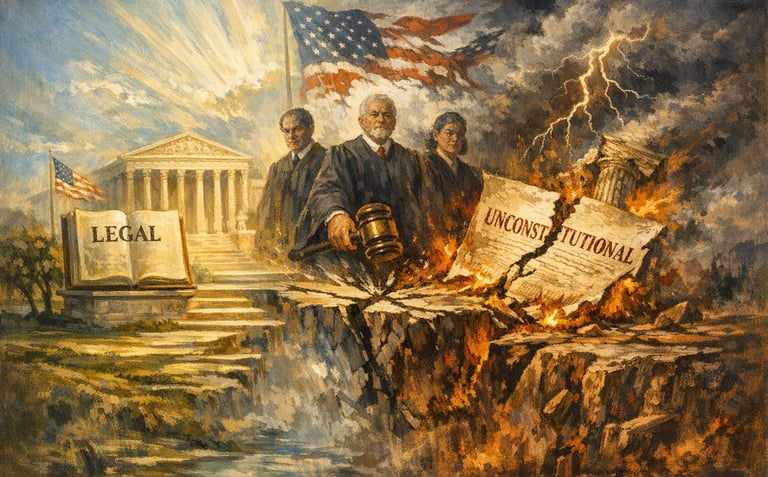
Legal v Constitutional - Part 1


Who Will Be the Next Eric Swalwell?
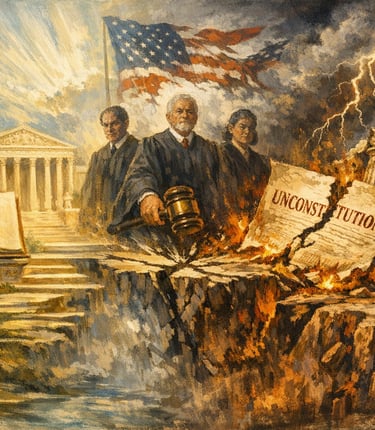
Statutes and Constitutionality
Various landmark court cases highlight how the courts have determined the unconstitutionality of certain statutes and policies. One of the most significant cases in this regard is Brown v Board of Education (1954). This ruling declared state laws establishing separate public schools for black and white students to be unconstitutional, effectively overturning the "separate but equal" doctrine set forth in Plessy v Ferguson (1896). The Supreme Court concluded that segregation in public education led to inequality, thus violating the Equal Protection Clause of the Fourteenth Amendment.
A more recent example of a law conflicting with the U.S. Constitution is a New York statute concerning concealed carry (of guns). This law was actively enforced by New York authorities for more than one hundred years. When it was finally challenged in 2022, the Supreme Court determined that it conflicted with the right to bear arms that is delineated in the Second Amendment and, as a result, deemed it to be unconstitutional.
Some may wonder why selected representatives would be willing to pass laws that conflict with the Constitution, particularly when each member must take an oath to uphold the Constitution in executing his/her representative role. The reasons are numerous, including self-interest or personal conviction in a certain matter. It could even involve altruism, believing it is best for the country. Still, it is good to be aware that legality does not equal constitutionality
Perhaps one of the most noted examples of the clash between legality and constitutionality is seen in the Supreme Court’s 2022 reversal of an earlier Court decision concerning abortion in Roe v. Wade, (1973). The difference here is that the legality of abortion was not a result of congressional statute nor of constitutional amendment, but of a ruling by the earlier Court. In the original case the Supreme Court, in a finding that purported to offer balance between a woman’s right to privacy concerning her body and the state’s interest in protecting life, proclaimed by fiat that to a certain point in a pregnancy, abortion must be deemed a woman’s constitutional right. Yet this decision, on its face, appears to directly conflict with the previously recognized unalienable right to life (for the child).
What might the 1973 Supreme Court have done constitutionally in the case of Roe? It seems the most reasonable argument is that the Court would be obliged to apply greater weight to one’s unalienable (inherent) right which, in this case, was the right to life. The justices would then have to acknowledge that neither the Court, nor mankind generally, can determine the precise moment a child’s life begins.
It is a responsibility of the government, including the courts, to protect the rights of the U. S. citizenry – particularly the right to life. If it is not possible for men to know the exact moment life begins, as a matter of cautious jurisprudence it seems the Court’s wisest approach would have been to presume that life begins at conception and rule in favor of protecting that life.
There has been some debate about which has primacy – unalienable rights or constitutional rights – when those rights appear to conflict. The founders seemed to recognize that unalienable rights are rights of the highest order in that they exist with or without the U.S. Constitution or the law. It is difficult to make the case that the Constitution supersedes natural rights when it was the very goal of the framers to fortify individual rights rather than weaken them. James Madison wrote in Federalist No. 51:
In the compound republic of America, the power surrendered by the people is first divided between two distinct governments, and then the portion allotted to each subdivided among distinct and separate departments. Hence a double security arises to the rights of the people.[1]
The primacy of unalienable rights is reinforced by the Fifth Amendment and the Fourteenth Amendment. The Fifth Amendment states that an individual may not be deprived of certain enumerated rights, including the right to life, without due process and the Fourteenth Amendment equally applies that restriction to the states. That portion of the Fifth Amendment reads as follows:
…nor shall any person…be deprived of life, liberty, or property, without due process of law.
In keeping with the premise that unalienable rights are primacy rights, the right to life should have been given primary consideration in Roe v. Wade. The unalienable right would have then outweighed a woman’s purported constitutional right to privacy (Fourteenth Amendment) that was used to elevate the right to an abortion to constitutional status. This would have precluded the Court from crafting and declaring a constitutional right via Court edict. The ruling fell outside the boundaries of the limited authority assigned to the Supreme Court as the constitutionally authorized devices of legislative statute or amending the Constitution were circumvented.
The second decision the Court might have made would have been to recognize that powers not delegated to the federal government must be left to the states (Tenth Amendment). This is a less persuasive position constitutionally, since the Court would have been leaving it up to individual states to determine when life begins, potentially violating the right to life. Still, it would have been a stronger constitutional decision. This is the reasoning the Court employed in overturning Roe in 2022. Nonetheless, in terms of legality, for forty-nine years abortion was deemed to be legal nationwide until the Supreme Court determined that the 1973 ruling lacked constitutional support.
While the above analysis will undoubtedly ruffle the feathers of many in the pro-choice crowd, these observations about Roe v. Wade are not intended to be political. On the contrary, they are expressly apolitical, as was the Court’s overturning of Roe. This can be seen in the fact that the pro-life community, many of whom are in favor of an unqualified abortion ban, is not thrilled about the Court’s most recent ruling.
In the 2022 decision, the Court did not remove a constitutional right, as many claim, since that right was not constitutionally based. In this case, the Court simply recognized that it is not the role of the Supreme Court to manufacture a constitutional right, as had been done in 1973. Neither did the Court criminalize abortion with this decision. They merely returned decisions about abortion to the individual states.
The late Ruth Bader-Ginsburg (1933-2020) was recognized even by her adversaries as a brilliant jurist. She served on the Supreme Court from 1993 until her death. Ms. Bader-Ginsburg was also a staunch pro-choice defender throughout her career. However, she recognized the inherent weakness of the Court’s 1973 decision and believed it might well be overturned if future justices were positioned to review the case. She understood that the reasoning employed by the Court made the decision vulnerable. In a 1984 speech given at the University of North Carolina she stated that, in Roe v. Wade, the Court “…ventured too far in the change it ordered and presented an incomplete justification for its actions.”[2]
The goal of this 2-part article is to help lay the groundwork for each reader to consider the distinction between legality and constitutionality and dig into a personal review of how statutes either contradict or harmonize with constitutional principles. Also be aware that, on occasion, the courts have erred even as the very purpose of judicial review is to assure that laws do not conflict with the U.S. Constitution. Once again, it is critical that the citizenry hold representatives, including the courts, to the highest possible standard.
________________________
[1] Madison, James, Federalist No. 51.
[2] Blake, Aaron, citing Ruth Bader-Ginsburg, What Ruth Bader Ginsburg really said about Roe v. Wade - The Washington Post, https://www.washingtonpost.com, accessed August 17, 2022
------------------------------------------------------------------------------If you enjoyed this article, please encourage your friends to visit us here at constitutionmatters.net where the Constitution really does matter.
See below for contact information

This book will truly enhance your understanding of the Declaration of Independence and the United States Constitution. Click the button below to check it out.
___________________________________________________________________________________________________________________________________________________________________________________________________


Contact
Questions? Reach out anytime.
Email:
contact@constitutionmatters.net
© 2025. All rights reserved.