
Men in Women's Sports and More
The inequities involved when women must compete against men
BLOG
Steven A. Carlson
9 min read


To see a list of all commentaries, click the above picture.




Understanding Individual Rights


Legal v Constitutional - Part 1
Legal v Constitutional - Part 2

Who Will Be the Next Eric Swalwell?
Transgenderism and the Equal Protection Clause
In recent years, a powerful debate has erupted in the United States. It is the debate/conversation surrounding the introduction of men into the world of womanhood. At the heart of the discussion is the transgender community (men who claim to identify as women). These individuals insist that since they identify as women, they must be treated as women in every facet of life. This has naturally led to discussions about certain practical matters such as whether those in the transgender community should share women's restrooms, locker rooms, prisons, sports, etc.
Those who support the position held by men who identify as women insist that it is not merely a claim. The argument is that these individuals are, indeed, women in every sense of the word and, as such, must be treated as women in every sense of the word. In an attempt to make their case, proponents have relied heavily on the Equal Protection Clause of the 14th Amendment. That clause states:
Since the claim is that men who identify as women are indeed, women, it is argued that refusing them access to facilities or events specifically designated for women violates their constitutional right. That is to say they are not receiving equal treatment under the law, which is what the Equal Protection Clause demands. This begs the question: Can a man be (or become) a woman? Unfortunately, that is not a question that can be answered to everyone’s satisfaction since many are in disagreement over the very meaning of the terms man and woman. Lacking agreement on that issue, the argument simply becomes circular.
Differences at Birth
Despite claims to the contrary, only two sexes are possible at birth. A child is either a male born with the physical characteristics that are specific to a male child, or a female born with the physical characteristics that are specific to a female child. At the moment of birth, science, the medical profession, and humanity in general have no other means to identify male and female other than these physical traits. Additionally, these biological realities do not naturally change over time, thus altering a person’s status as male or female.
A person’s existence as male or female extends beyond the visible physical characteristics that are instantly recognizable at birth. For instance, a male body consists of an X chromosome and a Y chromosome, while a female body has two X chromosomes. These are simple facts and these differences help explain why, over the course of time, a male body develops far differently than a female body.
Muscle development between males and females is influenced by a combination of biological, hormonal, and physiological factors. Males typically have more absolute muscle mass and faster muscle growth due to higher testosterone levels. Females, on the other hand, have less testosterone and higher estrogen generally resulting in slower muscle gain.
Given these common male characteristics, men who identify as women generally develop physically in the same fashion and at the same speed as other men. Consequently, if a man seeks to be a woman, and wishes to have a body that assumes female characteristics, this can only be accomplished through artificial means (hormone injections, surgery, etc.). It cannot happen innately. The same can be said of women who identify as men.
Since a man cannot assume a female form naturally, it must be that identifying as a woman is not a matter of being a female born into a male body. In other words, it is not a physiological issue. That means this claim of identification as the opposite sex can only be a matter of psychology. No other explanation is plausible.
While the above statements are true, this article is not focused on the moral, psychological, or emotional aspects of a person’s decision to assume the identity of the opposite sex. Such a decision is personal and, unless the individual is married, it is a choice that has little if any personal impact on others. At least, it does not impact other people unless and until the decision in some fashion encroaches upon their lives.
Personal Space
Many members of the transgender community (specifically men identifying as women) insist that their identification as women affords them the right to enter and use facilities designated specifically for women. This includes places like women’s restrooms and women’s locker rooms. However, attention to the rights of transgender individuals is not the only matter to be considered in this discussion.
There are innate biological differences between men and women, and those differences serve a purpose. In fact, certain of those differences serve a sexual purpose and there is something to be said for the notion that some places call for, and in fact demand a measure of privacy. This is especially true in places where women spend time dressing or undressing. After all, as much as equality is pushed in the feminist world, it does not change the fact that women are far more vulnerable to sexual assault than are men.
While a man may state verbally that he is a woman, those words do not change him physically. Consequently, it is possible for a man to imitate transgenderism. That being the case, predators could easily be motivated to identify as transgender in order to wrongly enter private spaces designated for females. Given that possibility/likelihood, it seems the safest approach where women are concerned would be to prohibit biological men – all biological men – from entering these kinds of spaces.
Additionally, it seems unreasonable, and certainly a violation of a woman’s rights, to tell her that she must share such spaces, and dress or undress in front of a man – any man. In fact, this one seems like a no-brainer. Do the rights of the transgender outweigh a woman’s right to a measure of privacy where it should be expected? Furthermore, consideration must be given to the privacy girls should be able to expect in high school restrooms and locker rooms. Surely the strongest argument is that the safety of our youth should be primary where this topic is concerned.
Men in Women’s Sports
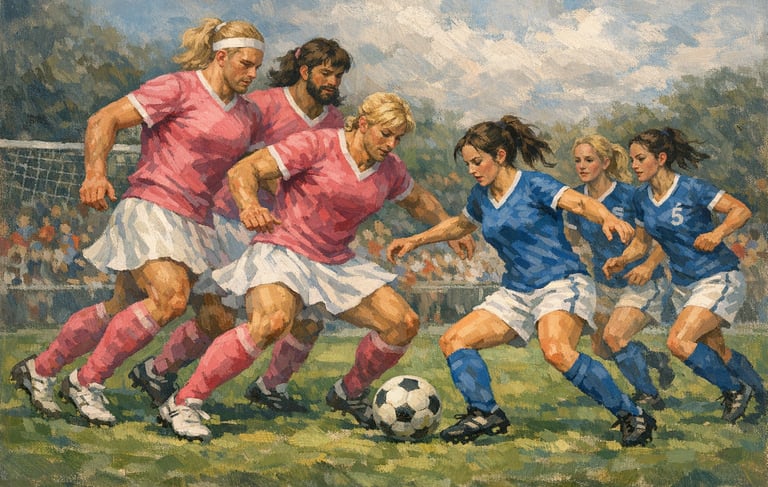
A major issue in today’s America is that, over the last couple of decades, many men have jumped into athletic competition with women. That is to say, men are competing against women in various sporting events that are specifically designated for women. Indeed, it has become a very serious issue, with potentially severe consequences.
One of the most significant arguments against co-ed competition in sports revolves around the physical differences between men and women. Men generally possess greater muscle mass and physical strength, contributing to superior performance in many sports. For instance, in sports like basketball and football, physicality and speed can often dictate the outcomes of games. As a result, women may not be able to compete on equal footing due to these biological differences. That is not intended as an insult to women. Rather it is a statement made in their defense. This discrepancy in physicality can lead to unbalanced competition, which is neither fair nor equitable. Indeed, women have lost in competition to men, causing them to lose awards, scholarships, etc.
While fairness is certainly a factor when it comes to men competing against women, it is arguably the safety factor that should be highlighted. A man’s extra muscle mass leading to additional strength and speed can prove dangerous for his female competitors. In fact, many women have been seriously injured. For instance, in 2022 a North Carolina female volleyball player was knocked unconscious when a trans-identified male spiked a ball and hit her in the head. In 2023, a trans-identified male athlete playing field hockey in Massachusetts threw a ball and knocked out the teeth of a female athlete.
These and other stories have become commonplace as men compete more and more in female sports. It is not surprising that many such incidents have been reported in high school and college sports programs as men reach their late teens and early twenties – a time when men’s muscles are often beginning to develop at a faster pace. This is especially true in college where men often develop far superior strength and abilities.
Title IX is a law passed in 1972 that was intended to improve opportunities for women who wished to compete in athletics – a world that was solidly dominated by men at the time. The statute states:
No State shall make or enforce any law which shall abridge the privileges or immunities of citizens of the United States; nor shall any State deprive any person of life, liberty, or property, without due process of law; nor deny to any person within its jurisdiction the equal protection of the laws.
No person in the United States shall, on the basis of sex, be excluded from participation in, be denied the benefits of, or be subjected to discrimination under any education program or activity receiving Federal financial assistance.
Unfortunately, some people carelessly turned this statute on its ear, insisting that transgender men must not, according to the law, be excluded from participation based on their gender identification. Indeed, for a while that argument won the day. In 2024, President Biden stretched the intent of Title IX beyond imagination, declaring that male transgender athletes must be allowed to participate in women’s sports. President Trump reversed that decision in 2025.
Conclusion
In January 2025, a federal district judge in Kentucky also found the move by the Biden administration to be outside the bounds of the intent of Title IX and struck down the administration’s decision. In that vein, states like Idaho and West Virginia have passed legislation stating that an individual must participate in sports based on that person’s biological sex. Laws passed by these two states have been challenged in court and lower courts have found that the statutes violated either the Equal Protection Clause or Title IX. Currently the two cases have been appealed to the Supreme Court, and people are awaiting a ruling.
How will the Supreme Court rule? When the Equal Protection Clause was written in 1868, questions about a person’s gender identity did not exist. That is because the differences between men and women were common knowledge and commons sense. When the 19th Amendment was ratified in 1920, providing women the right to vote, no one questioned to whom it should apply. Also, when Title IX became law, it was clearly intended to benefit biological women.
If the court takes into consideration 1) history, 2) science/biology, and 3) the unmistakable original intent of the Equal Protection Clause and Title IX, they will rule that these state statutes, banning transgender athletes from female competition, are in harmony with the Constitution. If they find otherwise, insisting that the Equal Protection Clause and Title IX apply to transgender athletes participating in women’s sports, that ruling would be far removed from anything anyone intended when these laws were passed. Such a ruling would be reckless and would turn the U.S. Constitution on its ear. It would also damage the world of women’s sports for the foreseeable future. In fact, it is noteworthy that the Olympic Committee recently determined that male transgender athletes will not be allowed to compete in women’s sports in the Olympics. Perhaps the Court will get the message.
While advocating for equality in sports is admirable, the inequity and safety concerns of compelling women to compete against men cannot be ignored. Recognizing the physical differences and unique challenges faced by female athletes is critical in shaping a more equitable and just sports landscape. Moving forward, it is vital for sports organizations, athletes, and fans alike to focus on creating an environment that encourages and celebrates the athletic accomplishments of women without forcing them to physically compete against men.
------------------------------------------------------------------------------If you enjoyed this article, please encourage your friends to visit us here at constitutionmatters.net where the Constitution really does matter.
See below for contact information


This book will truly enhance your understanding of the Declaration of Independence and the United States Constitution. Click the button below to check it out.
___________________________________________________________________________________________________________________________________________________________________________________________________


Contact
Questions? Reach out anytime.
Email:
contact@constitutionmatters.net
© 2025. All rights reserved.