The 27th Amendment - Prepare to Chuckle
A 200-year-old amendment is ratified
POLITICS
Steven A. Carlson
4 min read


To see a list of all commentaries, click the above picture.
Political Polls: Manufactured News - Part 1
Political Polls: Manufactured News - Part 3

Incoming Political Storm: The 2030 Census - Part 2
Political Polls: Manufactured News - Part 2
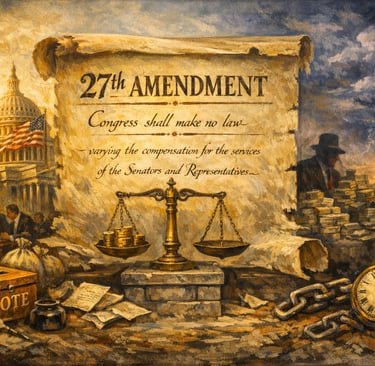
Congress sets its own pay by law, which is an obvious conflict of interest. Even the members who introduced this amendment acknowledged that problem. Their goal was to give citizens more say in how lawmakers’ salaries are decided. The idea was to stop Congress from granting itself a raise for personal gain by delaying when any pay increase could take effect. Under the amendment, no raise would kick in until after a new election had been held.
The Twenty-seventh Amendment was first sent to state legislatures for ratification in 1789, alongside ten other proposals that later became the Bill of Rights. It was the second of twelve amendments introduced at the time. Known as the Congressional Compensation Act of 1789, it was long thought to be dead. Only six states ratified it—five short of the required eleven—while five others rejected it in the 1790s. In 1873, amid backlash over a controversial congressional pay raise, Ohio briefly revived the amendment by ratifying it, but no other states followed.
The provision sat unnoticed for years until Wyoming quietly ratified it in 1978. Then, in 1982, a University of Texas at Austin undergrad named Gregory Watson wrote a paper arguing that the nearly two-century-old amendment was still viable. A Texas legislator’s aide caught wind of the idea, sparking renewed interest and kicking off a push for ratification. Finally, in 1992, Michigan became the thirty-eighth state to ratify it, securing the number of states needed for it to be adopted. Interestingly, according to Brittanica.com:
The 27th Amendment
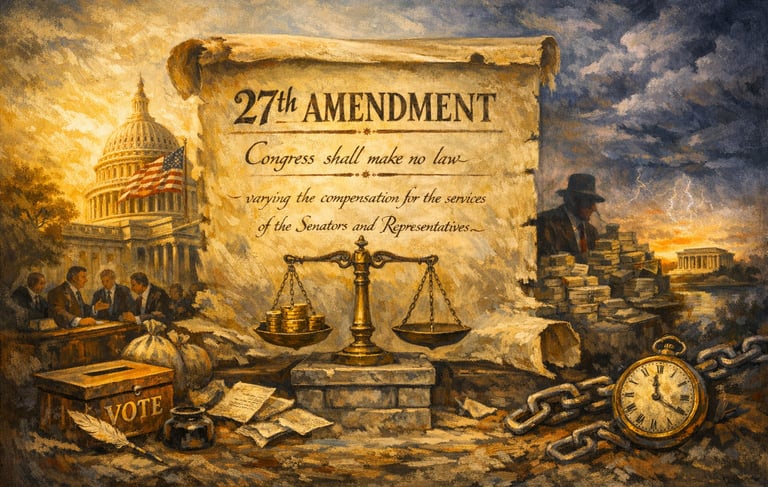
No law, varying the compensation for the services of the Senators and Representatives, shall take effect, until an election of Representatives shall have intervened.
The amendment’s ratification must have given Mr. Watson a sense of satisfaction. After all, he had accomplished something with a college paper that was unprecedented – a change in the way Congress conducts business. However, perhaps equally satisfying is the fact that, according to legaldictionary.net:
Watson had received a “C” for the paper, his professor saying that the argument that the amendment was still pending was not convincing.[1]
In early 2017, the University of Texas at Austin officially changed Watson’s term paper grade from a “C” to an “A.”[2]
The Twenty-seventh Amendment has had a notable impact. Before it was ratified, Congress often approved what many saw as overly generous pay raises, outpacing those in the private sector. In 1989, ahead of the amendment’s 1992 ratification, Congress passed The Government Ethics Reform Act, likely anticipating its approval. This law set up an automatic cost-of-living adjustment for members of Congress each year, based on the annual employment cost index. The last time this formula was used was in 2009, when congressional salaries increased by 2.8%, bringing the base pay to $174,000. Congressional leaders, like the Speaker of the House and the Senate’s majority and minority leaders, earn even more.
Since 2009, members of Congress have consistently voted against accepting the automatic pay adjustment outlined in The Government Ethics Reform Act. Whether that choice stems from ethical or political reasons likely varies among members, but the result is the same. The Twenty-seventh Amendment has clearly encouraged a more cautious approach when it comes to their own salary increases.
It’s hard to picture anyone challenging the constitutionality of the Twenty-seventh Amendment, especially since there’s no clear reason to do so. So far, no lawsuits have been filed. The only group that might benefit from overturning it would be federal legislators, but filing such a self-serving case would almost certainly hurt their chances of getting re-elected. As a result, the Twenty-seventh Amendment remains the most recent addition to the long list of amendments adopted over the more than two-hundred-year history of the U.S. Constitution.
For those who may be wondering if there are other amendments from days gone by that might resurface in the future, rest assured, there are not. It did not take long for early U.S. legislatures to recognize the quagmire that dangling amendments might cause. Consequently, very early on, amendments were given time limits for ratification. Beginning in the early 19th century, most proposed amendments were given a deadline of seven years. If at the end of seven years the amendment was not yet ratified, the proposal would become null and void. It just so happened that the 27th Amendment slipped between the cracks.
________________________
[1] Britannica, Twenty-seventh Amendment | Ratification, Congressional Pay, Limitations | www.britannica.com , Accessed March 11, 2026
[2] Legal Dictionary, 27th Amendment - Definition, Examples, Cases, Processes. www.legaldictionary.net, Accessed March 11, 2026
------------------------------------------------------------------------------If you enjoyed this article, please encourage your friends to visit us here at constitutionmatters.net where the Constitution really does matter.
See below for contact information


This book will truly enhance your understanding of the Declaration of Independence and the United States Constitution. Click the button below to check it out.
___________________________________________________________________________________________________________________________________________________________________________________________________


Contact
Questions? Reach out anytime.
Email:
contact@constitutionmatters.net
© 2025. All rights reserved.