
Birthright Citizenship and a Typhlotic Court Lesson 2: The 14th Amendment
A disturbing case of the blind leading the blind
Steven A. Carlson
8 min read

To see a list of all commentaries, click the above picture.
Legal v Constitutional - Part 1
Legal v Constitutional - Part 2


Men in Women's Sports and More
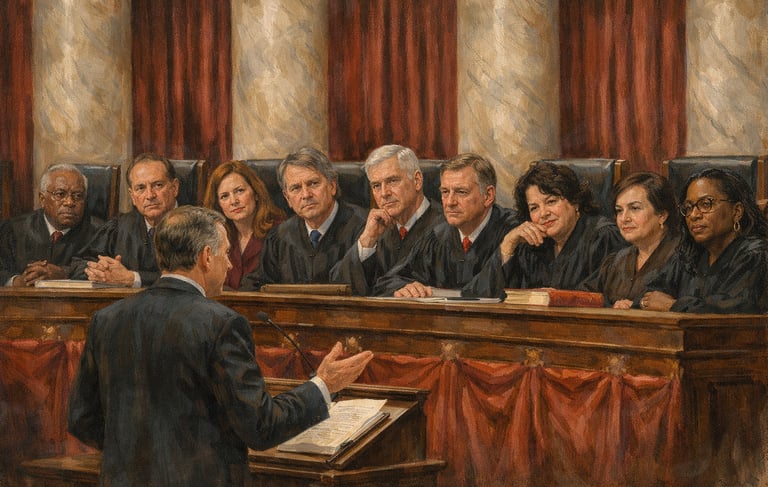
Birthright Citizenship and a Typhlotic Courtroom - Lesson 1: Esrly U.S. Citizenship
Neither slavery nor involuntary servitude, except as a punishment for crime whereof the party shall have been duly convicted, shall exist within the United States, or any place subject to their jurisdiction.
The Post Civil War Era
The Civil Rights Act of 1866 was designed to protect the rights of former slaves as well as all black citizens of the U.S. following the Civil War and the eradication of slavery. It was the first U.S. federal law to fully address the idea of the citizenship of the slave community. The first several sentences of the act read as follows:
Dear Visitor:
Thank you for your interest in constitutionmatters.net. Please be advised that in order to fully appreciate this commentary, it would be wise to first read Lesson 1 of this series. That lesson provides valuable foundational support for what you will read here. It can be found under Constitution Commentaries or Commentaries Alphabetical Listing in the menu at the top of the page.
The Civil War Era
In 1860 the Civil War broke out and would last roughly five years. Many attribute the Civil War, at least in part, to the results of the Dred Scott court case discussed in Lesson 1. While Dred Scott was not the cause of the war, it is easy to see that it was impactful in further dividing the nation. Dred Scott and the Civil War, to a large degree, changed political perspectives on citizenship, particularly where slaves were concerned.
The Civil Rights Act of 1862, signed into law on April 16, 1862, freed all slaves living in the federal district of Washington D.C. Shortly thereafter, on January 1, 1863, President Abraham Lincoln issued the Emancipation Proclamation, with the intent to release all slaves.
Believing the abolition of slavery deserved constitutional status, the 13th Amendment was introduced as a matter of removing slavery from all U.S. land. Originally introduced in early 1864, it met with strong opposition from Democrats. Needing of vote of two-thirds of both houses of Congress, it finally passed the Senate on April 8, 1864, but went no further. After his re-election in November 1864, Abraham Lincoln used the political capital from his re-election to pressure the House of Representatives who then passed the Amendment on January 31, 1865. The amendment was ratified by the states in December 1865. The amendment reads as follows:
I regard the bill to which the attention of the Senate is now called, as the most important measure that has been under its consideration since the adoption of the constitutional amendment abolishing slavery. That amendment declared that all persons in the United States should be free. This measure is intended to give effect to that declaration, and secure to all persons within the United States practical freedom. There is very little importance in the general declaration of abstract truths and principles unless they can be carried into effect, unless the persons who are to be affected by them have some means of availing themselves of their benefits.
All persons born or naturalized in the United States, and subject to the jurisdiction thereof, are citizens of the United States and of the State wherein they reside. No State shall make or enforce any law which shall abridge the privileges or immunities of citizens of the United States; nor shall any State deprive any person of life, liberty, or property, without due process of law; nor deny to any person within its jurisdiction the equal protection of the laws.
Civil Rights Act of 1866 CHAP. XXXI.—An Act to protect all Persons in the United States in their Civil Rights, and furnish the Means of their Vindication. Be it enacted by the Senate and House of Representatives of the United States of America in Congress assembled, That all persons born in the United States and not subject to any foreign power, excluding Indians not taxed, are hereby declared to be citizens of the United States; and such citizens, of every race and color, without regard to any previous condition of slavery or involuntary servitude, except as a punishment for crime whereof the party shall have been duly convicted, shall have the same right, in every State and Territory in the United States, to make and enforce contracts, to sue, be parties, and give evidence, to inherit, purchase, lease, sell, hold, and convey real and personal property, and to full and equal benefit of all laws and proceedings for the security of person and property, as is enjoyed by white citizens, and shall be subject to like punishment, pains, and penalties, and to none other, any law, statute, ordinance, regulation, or custom, to the contrary notwithstanding.
The Naturalization Act of 1870 established penalties for those who abused the naturalization system through falsely taking the oath or betraying the oath. However, perhaps the most important aspect of this act was that it gave foreigners of African descent the opportunity to access the naturalization process and become citizens of the U.S. This had previously been limited to those of the Caucasian race. This act did not deal with former slaves since that was handled in The Civil Rights Act of 1866 and the 14th Amendment of 1868. This was aimed toward individuals who arrived in America as foreigners who sought citizenship.
Several other laws regarding naturalization were passed into law in the late 1800’s, some of which denied the naturalization process to Asian prostitutes (Page Act of 1875) and even denied citizenship to Chinese (Chinese Exclusion Act of 1882). Another established a Bureau of Immigration and denied citizenship to polygamists (Immigration Act of 1891).
Perhaps one of the most important facts through the 1800’s was that the rules of the Naturalization Act of 1802 were still in effect. That law was not repealed. Consequently, the citizenship of the children of foreigners, including children born in the U.S., was always linked to the citizenship status of the child’s parents. That portion of the law reads:
This act was arguably introduced as a rebuke of the Supreme Court’s scathing renunciation of the citizenship of slaves in the Dred Scott case of 1857. While the text references “all people,” there is a limiting phrase, “not subject to any foreign power.” The ensuing statements in the text clarify that this act was about the inclusion of former slaves and their children.
It is important to note that this act did not repeal immigration laws previously passed by Congress and signed by the president. Consequently, foreigners who arrived in the U.S., along with their children were, according to the law, still subject to laws of naturalization including the oaths and allegiances set forth in those laws. Children born to parents who were not yet citizens were not granted birthright citizenship. The phrase, “not subject to any foreign power” would have naturally been understood as a reference to foreigners who had not yet completed the naturalization process and sworn allegiance to the U.S.
Senator Lyman Trumbull of Illinois was a key architect of what is known as the Citizenship Clause, which addressed the citizenship of slaves in the Post-Civil War era. It was never intended to sidestep or replace the requirements of the naturalization process for foreigners or their children. This truth is exhibited in the following, written by Senator Trumbull himself:
Prior to the period of Reconstruction, citizenship was generally determined by the states. An individual who was considered a citizen of a state was naturally considered a citizen of the United States. However, with millions of former slaves in their midst, there would undoubtedly be huge disparities, particularly among southern states, concerning their citizenship. This led Congress to pass The Military Construction Act (1867). This act placed the military in charge of uncooperative southern states. The return of southern states to civilian rule rested on two conditions. First, the voters of each state were required to frame a state constitution addressing black suffrage, guaranteeing black men the right to vote. Second, each southern state was required to ratify the 14th Amendment, guaranteeing citizenship to former slaves and their descendants.
The 14th Amendment
In the Post-Civil War United States, the southern states were wont to write laws subtly denying rights to former slaves and the black community. These laws were referred to as Black Codes. Consequently, it was determined by members of Congress that, like the emancipation of slaves (13th Amendment), citizenship for former slaves and their children deserved to be raised to constitutional status. Hence, the 14th Amendment was introduced in the legislature. The amendment simply sought to give The Civil Rights Act of 1866 constitutional permanence via the amendment process. Section 1 of the 14th Amendment reads as follows:
And be it further enacted, That the children of persons duly naturalized, dwelling within the United States, and being under the age of twenty-one years, at the time of such naturalization; and the children of citizens of the United States, born out of the limits and jurisdiction of the United States, shall be considered as citizens of the United States.
While it is not stated precisely in the amendment, the purpose here was specifically to protect the rights, privileges, and freedoms of former slaves and their families. That this was the purpose can be found in the debate arguments, but there is even more critical evidence. The first sentence of the clause is known as the Citizenship Clause. The author of the Citizenship Clause was the same Senator Lyman Trumbull who had authored a similar clause in the Civil Rights Act of 1866, which was discussed earlier. In that earlier instance, as noted in this article, Trumbull clearly explained that the phraseology was built upon the emancipation of slaves and their children.
It is important to note that the 14th Amendment, despite its quirky wording concerning jurisdiction, failed to repeal any portion of The Naturalization Act of 1802. In other words, The Naturalization Act of 1802 remained in full force and effect even after the ratification of the 14th Amendment. While the birthright Citizenship Clause of the 14th Amendment recognized the citizenship of “all persons born or naturalized…,” The Naturalization Act of 1802 recognized the citizenship of the children of foreigners, including children born in the U.S., only via the naturalization of the parents. Thus, the 14th Amendment and the Naturalization Act of 1802 appear on the surface to conflict. However, they were not considered contradictory because they were addressing separate matters of citizenship. One was focused on the birth of children whose parents had been slaves in America while the other addressed foreigners who entered the country and became citizens through the naturalization process.
Lesson 3 of this topic, which will appear on this site on Thursday, May 7th, will dive into certain Supreme Court cases of the late 19th century that have a direct impact on the topic of birthright citizenship. Readers will find the rulings from those court cases both insightful and surprising. Consequently, it is in your best interest to return to constitutionmatters.net for additional insights into the topic of birthright citizenship in the U.S.
End Lesson 2
------------------------------------------------------------------------------If you enjoyed this article, please encourage your friends to visit us here at constitutionmatters.net where the Constitution really does matter.
See below for contact information
This book will truly enhance your understanding of the Declaration of Independence and the United States Constitution. Click the button below to check it out.
___________________________________________________________________________________________________________________________________________________________________________________________________


Contact
Questions? Reach out anytime.
Email:
contact@constitutionmatters.net
© 2025. All rights reserved.