
Concerning California's Wealth Tax Proposal - Part 1
Digging into the Constitutional and Practical Ramifications
BLOG
Steven A. Carlson
6 min read


To see a list of all commentaries, click the above picture.

Political Polls: Manufactured News - Part 1
Political Polls: Manufactured News - Part 3


Political Polls: Manufactured News - Part 2
The 27th Amendment - Prepare to Chuckle
Introduction to California's Wealth Tax Proposal
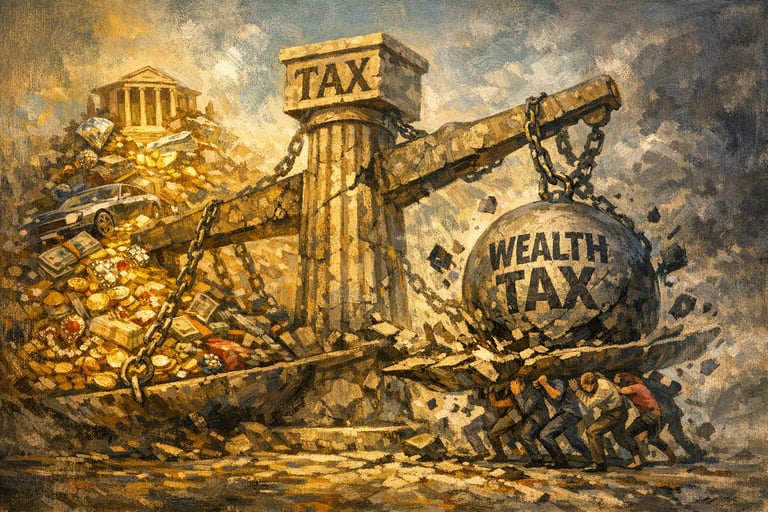
It is quite the conundrum. California’s 2026-2027 state budget looks to be approximately $350 billion. However, it is estimated that the state’s tax revenue will fall roughly $35 billion short of that amount. Consequently, a proposal has been introduced for the state to charge what is known as a wealth tax. Proponents are in the process of attaining the 875,000 signatures necessary to put this proposal on the November ballot.
What is a wealth tax? Where this particular proposal is concerned, the wealth tax is a tax on billionaires. Specifically, it is a 5% tax on the net worth of any individual in California whose total net worth exceeds $1 billion. It is estimated that this proposal will result in an additional $100 billion in tax revenue that would then be used primarily to mitigate healthcare costs for Californians.
The California proposal is not a singular element standing on its own that somehow simply appeared out of nowhere. For decades there has been an ongoing debate about wealth inequality in the United States that has led to a plethora of ideas aimed at redistributing wealth. It is a topic that has been coming from the lips of people like Senators Bernie Sanders and Elizabeth Warren for years. They have repeatedly pushed for aggressive governmental programs to make the rich poorer through taxation.
Understanding the Proposed Wealth Tax
California's wealth tax proposal is purportedly designed as a one-time tax based on an individual's net worth. The objective is to focus on high-net-worth individuals, suggesting that those with substantial financial resources should contribute more to the state's revenue. Proponents argue that introducing such a tax could help alleviate the financial burdens on lower-income residents by helping fund public services such as healthcare and education. However, a major question then arises. The question is: Who will determine a person’s net worth and what assets will be included in that calculation?
A person’s net worth is not measured by looking at bank statements to see how much money is in a bank account. Net worth eclipses bank accounts and considers all of a person’s assets. It includes real estate holdings, shares of stocks, etc. While the value of stocks traded in public markets may be easily determined, it is an enormous hurdle to fairly value ownership in a company that is not publicly traded. Similarly, the value of other assets like art work and other collectibles present challenging valuation issues. As an example, suppose a person has a family heir loom that has been passed down through generations. Who will measure the value of the asset? Additionally, if that heir loom is valued at $500K, it means the owner would be required to pay $25K for simply having in his/her possession an item that belonged to an ancestor.
Additional concerns arise with respect to the location of an asset. Should a person’s assets that are held outside the state of California be subject to a California wealth tax? Many California billionaires own real estate, businesses, and other property located in other states. In addition, it appears that a number of billionaires are seeking to leave California before the wealth tax would go into effect. In that vein, California is seeking to make the tax retro-active to January 1, 2026 in an effort to tax individuals who no longer reside in the state.
History of Progressive Taxation
Among nations that impose taxes based on the income of the citizenry, two basic philosophies exist. The first philosophy focuses on what is known as a flat tax (or flat tax rate). The idea behind the flat tax is that each individual/family should be required to pay the same tax rate on income regardless of the amount of that income. The reasoning is that each citizen should share in the cost of government offering a sense of ownership. The flat tax, it is said, motivates the citizenry to pay attention to how their money is spent by the government.
Roughly forty countries around the world (about 20% of all nations) currently rely on a flat tax system. These include countries like Bolivia, Bulgaria, Georgia, Guernsey, Hungary, and a host of other nations. The flat rates at which people are taxed range from 10% in a number of countries to a high of 25% in Belize. Interestingly, many of the nations that now boast a flat tax system have done so within the last forty years and much of the change has come as these nations have exited a socialist form of government. Overall, outcomes have been favorable where the flat tax has been implemented, boosting GDP and strengthening economic markets.
In 2025, Michal Brzezinski and Mahmut Zeki Akarsu published an abstract titled The Impact of Flat Taxes on Income and Wealth Inequality. Included in their findings was the following statement.
Flat tax systems have gained traction in countries that transitioned from socialism, with more than 20 nations in Eastern Europe and Central Asia adopting such systems since the mid-1990s.[1]
A second taxation philosophy is known as progressive taxation. Proponents of progressive taxation embrace the philosophy that in a society, those with greater financial income/wealth should pay a higher percentage (often a significantly higher percentage) of their income to support the work of the government. Progressive taxation is also often coupled with the idea that the government might, through the taxing system, redistribute the wealth of the haves among the have-nots through assorted government social programs. Progressive taxation is generally favored by nations with a bent toward socialism. Interestingly, the United States’ income tax and the income tax policies in several states are built on a progressive taxation philosophy.
A wealth tax, which is currently being considered in California, raises the idea of progressive taxation to an even higher level. While many states impose a property tax on real estate ownership, a wealth tax is not that, even though there are similarities. Unlike a property tax, however, a wealth tax is geared toward stripping wealthy individuals of a portion of their after-tax accumulated assets. A wealth tax is not imposed to fund basic government services, which is the role of property taxes and income taxes. The idea behind a wealth tax is that a state can apply this financial resource to social programs to help those less fortunate. In other words, a wealth tax is primarily seen as a means of wealth redistribution.
A major question with respect to the imposition of a wealth tax like that currently proposed in the state of California is whether it is in keeping with taxation principles outlined in the U.S. Constitution. Part 2 of this essay will dig into the U.S. Constitution and seek to determine how a wealth tax stacks up.
End Part 1
[1] Brzezinski, Michal, and Akarsu, Mahmut Zeki, The impact of flat taxes on income and wealth inequality, accessed March 19, 2026.
------------------------------------------------------------------------------If you enjoyed this article, please encourage your friends to visit us here at constitutionmatters.net where the Constitution really does matter.
See below for contact information


This book will truly enhance your understanding of the Declaration of Independence and the United States Constitution. Click the button below to check it out.
___________________________________________________________________________________________________________________________________________________________________________________________________


Contact
Questions? Reach out anytime.
Email:
contact@constitutionmatters.net
© 2025. All rights reserved.