Government - A Necessary Evil?
Yes...but it is unnecessarily evil
5 min read
To see a list of all commentaries, click the above picture.


The Cost of Individual Rights


Life - No Longer an Unalienable Right?


Does the Press Have a "Right" to a White House Pass?


Not Your Father's Mid-Term Election


A Reasoned Formula
Human history is filled with quality literature, both fiction and nonfiction. While exceptional works are plentiful, a strong argument can be made that the Declaration of Independence and the Constitution of the United States are two of the finest documents ever written. The Declaration of Independence, with its reasoned logic concerning the purpose and role of government, combined with its recognition of unalienable rights, offers a striking portrait of an idyllic relationship between a government and the governed.
It is said that a three-legged stool does not wobble. Indeed, three legs actually prevent the stool from wobbling because the feet of the three legs are always on the same plane. For this reason, a three-legged stool stands firm even when placed on an uneven floor. This was the idea behind the three-pronged approach to government established by the framers of the U. S. Constitution. The three legs of the U. S. government (legislative, executive, and judicial), are intended to keep each other in check so that no branch of government achieves too much power.
Equally important is the fact that, in the United States, the representatives in government are chosen by the people. The intent, in keeping with the ideals advanced in the Declaration of Independence, is that a government should only have power and authority that is approved by the citizens it represents. The purpose of government is not to lord over the people, but to provide for a peaceful coexistence for mankind.
The Source of Evil
Thomas Paine, in his insightful work titled Common Sense, made the observation that “government, even in its best state, is a necessary evil; in its worst state, an intolerable one.”[1] What follows here is a qualified agreement with these comments. For instance, Thomas Paine is correct in that government is necessary, particularly where sizeable populations are expected to live together in harmony. In theory, it is the role of government to provide the citizenry with a social environment that will allow that harmony to flourish.
Paine’s conclusion that government “is a necessary evil” is true in a sense, but the better case can be made that government is unnecessarily evil. Government might be considered an entity, but it is not, in itself, a living and breathing being. It is a human invention. It consists of, and draws its breath from, people. Government has no emotions or cunning. It has no more inherent evil intent than a table or a lamp, both of which are inventions of men.
The evil by which Paine characterized government can only be attributed to the fact that the offices of government are occupied by human beings. Consequently, a government tends to take on the characteristics of those inside that government whose motives are less than pure. Have men of flawed character and questionable intentions occupied the White House? Does Congress consist of many individuals whose self-interests outweigh their concerns for the well-being of their constituents? Have judges sat in courtrooms, and even behind the bench of the Supreme Court, who have little regard for the Constitution? The answer to each of these questions is a resounding yes! One need only weigh the words of the Constitution against the multitude of dubious rulings delivered by the courts to recognize these failures.
These observations do not apply universally. Some individuals do enter the world of politics out of a sense of patriotism and a sincere desire to make America a great place to live. Additionally, judgeships have, at times, been occupied by justices who fully embrace both the text and the spirit of the U. S. Constitution. Still, the old cliché is true in that power corrupts and absolute power corrupts absolutely. For this reason, it is critical that citizens hold to account those in positions of authority at all levels of government (local, state, and federal).
Applying the Constitution
There is a fundamental misunderstanding where the Supreme Court is concerned that has led to bold disregard for the Constitution. Much of the citizenry and many justices seem to believe it is the role of the Supreme Court to generate the meaning of the Constitution. They believe the Constitution means what the Court says it means even if the result contradicts a plain reading of the text. This confusion is a result of the Court’s inconsistent and sometimes flawed application of constitutional principles. Consequently, many people are less concerned with the words of the Constitution and more concerned with the words coming from the Supreme Court.
The founders never intended for the Court to give new meaning to a Constitution that is plainly written or to stretch that meaning beyond reasonable limits. In the Federalist Papers it is made clear that it is the role of the Court to evaluate the legitimacy of a statute (written by Congress) by viewing it through the lens of constitutional constraints. According to Alexander Hamilton, writing in Federalist No. 78, it is the Court’s role to ascertain the meaning of the Constitution rather than to create that meaning.
The interpretation of the laws is the proper and peculiar province of the courts. A constitution is, in fact, and must be regarded by the judges, as a fundamental law. It therefore belongs to them to ascertain its meaning, as well as the meaning of any particular act proceeding from the legislative body. If there should happen to be an irreconcilable variance between the two, that which has the superior obligation and validity ought, of course, to be preferred; or, in other words, the Constitution ought to be preferred to the statute, the intention of the people to the intention of their agents.[2]
Conclusion
Thomas Paine was right in that government is a necessary evil, but it is also true that government need not be evil if the people’s representatives are honorable. Unfortunately, finding such people who are willing to serve in a representative republic is a challenge. The power that is naturally accessible to those in government tends to attract people who are attracted to power. Still, it is not unreasonable to believe that the design of the representative republic developed by the founders and delineated in the Articles of the U. S. Constitution may be the best history has to offer.
________________________
[1] Paine, Thomas, Common Sense, Fall River Press, 1995, p. 1.
[2] Hamilton, Alexander, Federalist No. 78.
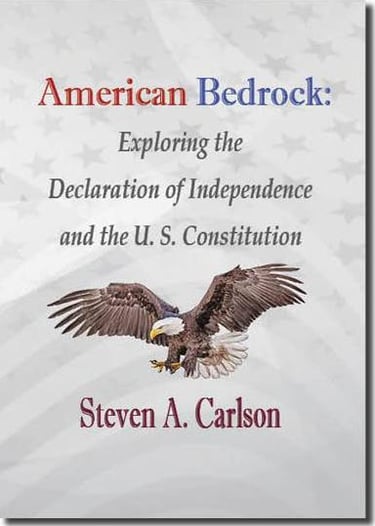
This book will truly enhance your understanding of the Declaration of Independence and the United States Constitution. Click the button below to check it out.
______________________________________________________________________________________________________________________________________________________________________________
Feel free to visit restoretheword.com
Contact
Questions? Reach out anytime.
Email:
contact@constitutionmatters.net
© 2025. All rights reserved.