Proposal for the 28th Amendment to the U.S. Constitution
Is it time for a Constitutional Convention?
Steven A. Carlson
10 min read

To see a list of all commentaries, click the above picture.

Birthright Citizenship and a Typhlotic Courtroom - Lesson 4: Wong Kim Ark
Birthright Citizenship and a Typhlotic Courtroom - Lesson 5: 20th Century U.S. Citizenship
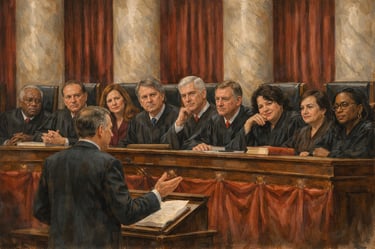
Birthright Citizenship and a Typhlotic Courtroom - Lesson 6: Oral Arguments


DJ Trivia and the Problematic Preamble


A Stroke of Genius
It was a great idea. The intent was to establish a nation where the citizens would be in charge. It would be the citizens controlling the government rather than the reverse. It would be a true republic grounded in democratic principles. While we have a list of founding fathers, what many don't know is that certain women were very influential where the founding of the United States is concerned. One such woman, an influential Philadelphia socialite who might rightfully be considered a founding mother, was Elizabeth Willing Powel. Following the signing of the U.S. Constitution on September 17, 1787, a conversation purportedly took place between Elizabeth Willing Powel and Benjamin Franklin that went as follows:
Powel: Well, Doctor, what have we got, a republic or a monarchy?
Franklin: A republic, if you can keep it.
The lady’s query was honest and insightful – Franklin’s response was profound. In fact, it might be said that his response was prophetic. It seems that no matter who is elected into federal office – whether it is the presidency or Congress, a monster keeps creeping up behind us. It is a monster capable of completely decimating this nation and it is one of which most people are unaware. In describing that monster, John Adams is credited with the following statement:
The U.S. arguably has the most powerful military on planet earth, so it is unlikely that we will be subdued militarily. However, we are unfortunately in grave danger of being swallowed by national debt and, again, it does not matter who we elect, that debt continues to grow. While most who are semi-alert politically understand that the national debt now exceeds $38 trillion, sadly enough, that is but the proverbial tip of the iceberg. What is even more troubling is unfunded federal liabilities that have the potential to reduce the U.S. to financial rubble over the next two decades.
What are unfunded liabilities? These are future payments that have been promised by the federal government while the government lacks the wherewithal to meet those payments. These debts do not appear on reports presented to the public for consideration. We have been told that the nation is $38 trillion in debt, which is true. However, this does not include $86.6 trillion in unfunded liability as of the end of 2025. This unfunded liability consists of $175 trillion in payments measured against roughly $89 trillion in anticipated revenue over the next ten years. Additionally, we can assume that the government will add $1 trillion/year to the $38 trillion debt (which is a separate matter from unfunded liabilities), leading to a $48 trillion debt. Adding the $48 trillion in debt to the $86.6 trillion in unfunded liabilities, it seems the real U.S. financial obligation over the next ten years amounts to roughly $135 trillion.
What is included in unfunded liabilities? The primary drivers of this debt are Social Security, Medicare, Medicaid, and federal employee pensions and benefits. It is projected that the Social Security and Medicare funds will be depleted by 2033…just seven years in the future. Of course, the numbers are staggering and the consequences shocking.
How did we get here? In a word…it is Congress. We have a Congress that knows no spending limits. Additionally, Social Security is a program that could never stand the test of time as people live longer and the uses of this fund have expanded to pay for a multitude of unintended conditions. In the meantime, we send Congressmen and women to Washington where, on a generous salary of $174,000/year, they often seem to be able to build net worth in the millions. There is simply something wrong with this picture.
These things having been said, no one seems to be able to address these issues. What needs to be done? First, the citizenry needs to put the brakes on Congress by limiting what they are allowed to spend. Second, it seems wise to limit the amount of time any Congress person can remain on the job. Third, Congress must suffer the consequences of failing to control spending. Consequently, I am proposing the following as the 28th Amendment to the U.S. Constitution. These may sound like they are harshly worded, but it is what to expect when faced with the monster that might easily destroy this nation in short order.
There are two ways to conquer and enslave a country. One is by the sword. The other is by debt.
The powers not delegated to the United States by the Constitution, nor prohibited by it to the States, are reserved to the States respectively, or to the people.
28th Amendment Proposal
Section I
The United States shall not incur any deficit in the budget for any fiscal year. The total outlays of the Federal government shall not exceed its total revenues for that year, except in times of declared war. In any year that U.S. spending exceeds revenues, any Congress person whose term expires within two years of the end of that fiscal year may not seek re-election. Members of the legislature who hold office at the time of ratification of this amendment are exempt from this provision.
Section II
The United States Congress shall be limited in the number of terms that members may serve. No member of the House of Representatives shall serve more than nine 2-year terms, and no member of the Senate shall serve more than three 6-year terms. No member of Congress may exceed 24 total years of elected service in the legislative branch. Members of the legislature who hold office at the time of ratification of this amendment are exempt from this provision.
Section III
Members of the U.S. House of Representatives and the U.S. Senate are forthwith prohibited from purchasing and selling publicly traded stocks while in office, ensuring that legislators act in the best interest of the public and maintain an ethical standard of transparency and accountability. Members of the legislature who hold office at the time of ratification of this amendment are exempt from this provision.
Section IV
Federal grants issued to non-government organizations (NGO's) are limited to a maximum of 1% of the annual federal budget. All NGO's receiving federal grants must provide detailed annual financial reports to a designated federal oversight committee. Additionally, every NGO receiving federal funds may be subject to federal audit without warning and must undergo a federal audit no less than every three years with the audit covering the entire three-year span. Congress will establish a pass/fail standard by which an NGO audit will be measured. Failure to pass such an audit will result in denial of future federal grants.
Congress must create and maintain a federal database, available to the public, of all NGO's receiving more than $1 million in federal grants. This database must include the names, positions, and compensation of officers of the NGO as well as the purpose of the grant and performance metrics. Funds distributed to all NGO's must be delegated to specific purposes outlined in grant contracts.
Section V
No member of the U.S. House of Representatives or the U.S. Senate may, upon leaving that elected office either through retirement, failure to win re-election, or any other reason, work for a lobbying firm for ten years after leaving their elected office. This includes working as an employee, adviser, board member, or independent contractor. Neither may a legislator begin his/her own lobbying firm or join with anyone as a partner in a lobbying firm for ten years after leaving office.
Section VI
All federal employees, including members of the U.S. legislature, shall be subject to the same laws enacted by Congress that govern the citizens of the United States, ensuring no individual within the federal government is exempt from the laws affecting the populace.
Why should current members of Congress be allowed exemption from certain provisions of this amendment? This is simply a practical matter. For a proposed amendment to be accepted as a constitutional amendment, it must gain support from three-fourths of the states and two-thirds of the legislature. Unfortunately, two-thirds of the legislature will not willingly vote themselves out of a job or approve any measure that impacts their personal opportunities - present and future. However, they may be very willing to limit the terms and opportunities of future legislators. The question remains whether state legislators with federal aspirations would be willing to limit their own future opportunities.
For those who might be concerned that Section IV would prohibit the federal government from interacting with businesses, that is not the case. NGO's are not businesses. An NGO is an organization that receives dollars from the federal government for loosely defined purposes. The NGO then decides exactly where and how that money will be spent. NGO's are not businesses or independent contractors. The database of NGO's is a particularly significant feature of Section IV. After all, taxpayers surely have a right to know if any members of the legislative branch sit on the board and/or receive compensation from any organization in charge of spending tax dollars.
Of course, the details and exact wording of this proposed amendment may be debated, but the substance is important and critical to the well-being of the country. If the goal is for the people to control the government rather than vise-versa, the only way to do that is to limit spending by a government that has no real grasp of what it means to stay in budget. Part of the problem is that too many members of Congress spend 30-40 years (or more) in Washington, completely disconnected from the people they purportedly represent, leading to a slothful Congress. Indeed, it is undoubtedly this kind of legislative laziness that has led to what is likely trillions of dollars in fraudulent use of tax dollars over the last few decades.
This article does not delve into the consequences of out-of-control debt and staggering unfunded liabilities. That is a discussion for another time - one that I will get into in the next couple of weeks. Suffice it to say, however, that the results are not pretty. This kind of debt does not bode well for the future of the nation.
Perhaps you have ideas of your own that might, through the amendment process, begin to slow the monster that is so close to devouring our nation. If you have any ideas, feel free to email them to contact@constitutionmatters.net. In fact, there may be ways to make changes outside the amendment process, but I currently know of none that would exact the kind of change that is needed. These are just my initial thoughts, but there can be no doubt that Washington is out of control and far too many people spend their lives and careers in Washington making the situation worse. Perhaps limiting someone's stay in the federal government would help change some attitudes.
********************
During the Constitutional Convention of 1787, the delegates engaged in some rather explosive debates over the wording of the 10th Amendment. As written, that amendment reads as follows:
The amendment appears to limit the reach of the federal government, which was purportedly the intent, so exactly what caused the uproar among the delegates in 1787? This amendment was a carry-over from Article II of the Articles of Confederation, which was a precursor to the U.S. Constitution. However, the language of the 10th Amendment varied slightly from what existed in the Articles of Confederation where we find the following:
Each state retains its sovereignty, freedom and independence, and every Power, Jurisdiction, and right, which is not by this confederation expressly delegated to the United States, in Congress assembled.
Each of these statements is undeniably meant to limit the power of the federal government, recognizing that primary control lay with the states. The intent was to limit the authority of the federal government to those duties and responsibilities designated to the federal government by the Constitution. However, there is a subtle difference between these statements, and it is that difference that caused the uproar in 1787.
Notice that, in the Articles of Confederation, the federal government was limited to those duties and responsibilities “not…expressly delegated” to that federal government. However, in the 10th Amendment, the limit was reduced to “powers not delegated.” Is there a significant difference between powers not delegated and powers not…expressly delegated? The concern during the convention was that by eliminating the word expressly, the federal government might take license and cross an authoritative line it was supposedly prohibited from crossing. Indeed, that is what happened as the courts specifically highlighted the absence of the word "expressly" in allowing the federal government to cross forbidden boundaries time and again. It is this kind of federal attitude that has brought us to the point where the U.S. faces $135 trillion in debt and unfunded liability over the next decade.
What is to be done? It seems it is time to go back to the drawing board and, once again, through the amendment process, install the word "expressly" into the 10th Amendment. Needless to say, this would require establishing a plan for reducing federal involvement in all areas not delegated by the Constitution and shrinking the size of the federal government considerably.
There are, of course, a multitude of additional steps that would be needed to roll back a plethora of statutes and agencies that would have been prohibited by the Constitution had the 10th Amendment maintained the wording of the Articles of Confederation. What is unequivocal, however, is recognition that the United States of America cannot continue down the current path.
------------------------------------------------------------------------------If you enjoyed this article, please encourage your friends to visit us here at constitutionmatters.net where the Constitution really does matter. Also, if you appreciate the articles and insights provided here, feel free to contribute to the cause by clicking below.
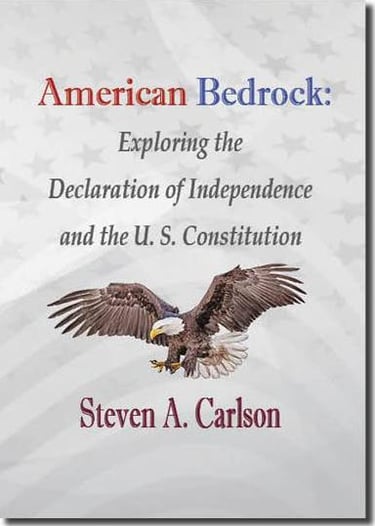

This book will truly enhance your understanding of the Declaration of Independence and the United States Constitution. Click the button below to check it out.
___________________________________________________________________________________________________________________________________________________________________________________________________


Contact
Questions? Reach out anytime.
Email:
contact@constitutionmatters.net
© 2025. All rights reserved.