Congress's Duty to Rein in Democratic Socialism
Article IV and Congressional Responsibility
Steven A. Carlson
8 min read

To see a list of all commentaries, click the above picture.


Insights into the Declaration of Independence
Wolf in Sheep's Clothing




The Rise of Populism in America - A House Divided
Democratic Socialism v the U.S. Constitution


Congressional Responsibility
As most readers are aware, the term Democratic Socialist has been tossed around rather freely in this, the 2026 election cycle. Dozens of individuals (roughly 150) wearing that label and receiving backing from the Democrat Socialists of America (DSA) have tossed their hats into the political ring, vying for seats in the U.S. House of Representatives and the U.S. Senate as well as a number of seats in various state legislatures. For those who hold constitutional principles in high esteem, the notion that this movement might begin to make headway into our political system is disconcerting.
While the Democrat Party has always been a left-leaning organization with a bent toward socialist ideals, it is important to distinguish between Democrats and Democratic Socialists. What exactly is that distinction? It is simply the way they view the word Democrat. The left-leaning Democrat Party seeks to turn the U.S. into a nation resembling semi-socialist states like Norway, France, Spain, and other countries built on socialist principles. They see the potential for a fully socialist society in America, but that is a long-term dream. Democratic Socialists, on the other hand, seek to fully abandon constitutional principles. Their ultimate goal is to completely demolish our republic and rebuild it as a full-fledged communist regime as quickly as possible. Consequently, the label Democratic Socialist can rightly be replaced with either Socialists or, even more fitting, Communists.
Over the last several decades the Democrat Party has slowly but surely drifted farther and farther to the left with each political cycle, so an uprising of far-left communists should not surprise anyone. That is always where the Democrat Party was headed - eventually. Evidently that leftward movement has not been robust enough or fast enough for those with powerful communist beliefs, so they have become much more aggressive for the 2026 mid-terms.
While a number of political primaries have yet to take place, it is concerning that more than thirty of these radically left candidates have survived and their names will appear on ballots around the country in November. Naturally, these candidates have reached the ballot in highly blue districts, but that means some of them could actually win congressional seats. There will likely be very few that reach the House (this is less likely for the Senate), but even a few wins will undoubtedly be viewed as an opening into those chambers to push their agenda forward.
Senator Bernie Sanders of Vermont could rightfully be credited with the growth of the socialist movement in America, having twice run for president under that banner. Joined by the likes of Alexandria Ocasio-Cortez, a popular New York congresswoman, they have made the label attractive. Still, any attempt at quickly reconstructing America into a communist state at the federal level would be a daunting task and would ultimately end in failure. Instead, the movement will undoubtedly begin to take root, where possible, at the local and state levels.this nation into something other than a constitutional republic.
There is, in the U.S. Constitution, a little-known built-in defense mechanism against any attempt to discard the Constitution and rebuild this nation into something other than a constitutional republic. Rooted deeply in the framework established by the Founding Fathers of the United States, Article IV of the U.S. Constitution specifically outlines the obligations of Congress in safeguarding the republican form of governance across all states. It places upon Congress the responsibility to assure that individual states maintain a constitutional republic, a form of government consistent with constitutional principles. According to Article IV, Section 4 of the Constitution:
The United States shall guarantee to every state in this union a republican form of government, and shall protect each of them against invasion; and on application of the legislature, or of the executive (when the legislature cannot be convened) against domestic violence.
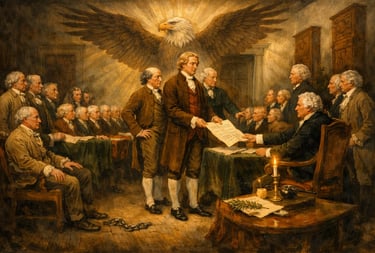
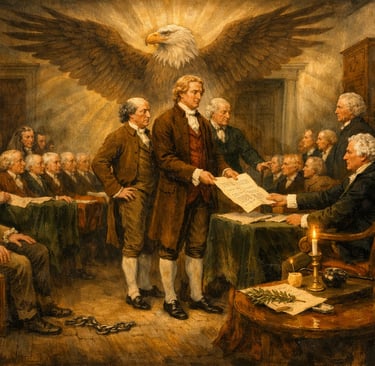
We hold these truths to be self-evident, that all men are created equal, that they are endowed by their Creator with certain unalienable Rights, that among these are Life, Liberty and the pursuit of Happiness. That to secure these rights, Governments are instituted among Men, deriving their just powers from the consent of the governed.
Defining the Character of a Constitutional Republic
This statement spells out in no uncertain terms the responsibility of Congress to assure that each state in the union maintain a republican form of government. To understand the essence of this congressional responsibility, it is important to first understand what a republican form of government entails. The term "republic" originates from the Latin "res publica," meaning "public matter." A republic emphasizes the role of the public and the governance of elected representatives rather than a monarchy or dictatorship. This principle was well-established in the following excerpt from the Declaration of Independence as the Founders recognized that a just government can only derive its authority through the consent of the governed.
The foundational idea is that sovereignty resides with the people, and elected officials serve at their discretion and on their behalf. Article IV, Section 4 of the Constitution could not have been written more plainly. This critical section of the Constitution places a significant obligation on Congress to intervene if any state fails to maintain a form of governance that aligns with republican principles.
There have been occasions in American history when Congress has exercised its powers to ensure that states adhere to the republican form of government. Assorted historical examples illustrate congressional action in ensuring state compliance. For example, one notable instance occurred during the Reconstruction Era following the Civil War. Congress enacted the Reconstruction Acts, which required Southern states to restructure their governments to comply with the constitutional mandates. The Reconstruction Acts were vital in transforming the political landscape in the South and providing protections for the previously subjugated slave populations. Several southern states sought to continue to marginalize these individuals through subtle wording of their laws (Black Codes). Congress saw through this and made each state’s participation in the union’s political processes dependent on their adherence to constitutional principles.
The constitutionally-defined relationship between federal and state governments is a crucial feature of this responsibility. While the Constitution delineates powers between these two levels of government, the overarching responsibility of Congress is to ensure that states do not violate the core tenets of democracy and individual rights. When state laws or actions infringe upon the rights protected by the Constitution, Congress not only has the authority, but is compelled by the Constitution to intervene and enact legislation to rectify these issues. This foundational principle upholds the balance between respecting state sovereignty and ensuring that the national commitment to republican governance is honored.
It is Congress’s responsibility to be both aware and responsive to instances when states attempt to enact laws or policies that undermine constitutional principles. This includes providing checks and balances through oversight mechanisms, encouraging citizen participation, and facilitating avenues for citizens to peacefully challenge state actions that infringe upon their rights. By doing so, Congress not only upholds the constitution but also fosters a vibrant constitutional republic where citizens are engaged and informed about their governance.
It Begs the Question
The question is not whether Congress has the authority and/or obligation to protect constitutional principles and a republican form of government at the state level. These are unequivocally delineated in Article IV, Section 4. There are, however, two probing questions that must be answered – and soon. 1) At what point will the rise of socialism/communism in America demand congressional action? And 2) Will Congress actually have the fortitude to act?
At what point will the rise of socialism/communism in America demand congressional action? Some will say we have reached that point and beyond. Should Congress take action as states seek to institute a wealth tax, which is a stalwart of socialist regimes? Perhaps Congress should consider taking action when personal properties are seized by local/state governments without due process, or when governments begin to try a takeover of manufacturing sectors in their cities and states. Maybe Congress will act as free speech is diminished or banned and other civil rights are heavily restricted. All of these will eventually happen if communism is allowed to gain strength.
Will Congress actually have the fortitude to act? This is perhaps the bigger question. Socialism has already begun to gain a small, but not insignificant foothold. While Congress consists primarily of Republicans and Democrats, there are those among the Democrat Party who have begun to eye socialism more favorably, seeing it as an opportunity to gain and retain power. These few, along with a left-leaning majority of Democrats, no longer appreciate the nation’s foundational values and will likely seek to stifle congressional action in resisting this socialist/communist movement. Sadly, even weak, squeamish Republicans, of which there are many, will be hesitant to take the necessary steps to squelch this movement.
Conclusion
Looking ahead, as new challenges emerge, it is imperative that Congress remains vigilant in fulfilling its obligations stipulated by Article IV. With the increasing polarization of American politics and state-level initiatives that potentially infringe on civil liberties, the responsibility of Congress to assure that each state maintains a republican form of government is more critical than ever.
The responsibility of Congress to ensure each state maintains a republican form of government as stated in Article IV is paramount for preserving the integrity of a constitutional republic. Congressional intervention is essential when states fail to uphold constitutional principles or begin to infringe on individual rights. By maintaining an active role in monitoring and guiding state governance, Congress reaffirms the commitment to the U.S. Constitution. Congress must be prepared to meet these challenges head-on, ensuring that the republic remains vibrant, and it is up to us, as citizens, to remind them.
------------------------------------------------------------------------------If you enjoyed this article, please encourage your friends to visit us here at constitutionmatters.net where the Constitution really does matter. Also, if you appreciate the articles and insights provided here, feel free to contribute to the cause by clicking below.


This book will truly enhance your understanding of the Declaration of Independence and the United States Constitution. Click the button below to check it out.
___________________________________________________________________________________________________________________________________________________________________________________________________


Feel free to visit restoretheword.com
Contact
Questions? Reach out anytime.
Email:
contact@constitutionmatters.net
© 2025. All rights reserved.