Insights into the Declaration of Independence
A Seeming Inconsistency
Steven A. Carlson
8 min read
To see a list of all commentaries, click the above picture.
Birthright Citizenship and a Typhlotic Courtroom - Lesson 6: Oral Arguments
DJ Trivia and the Problematic Preamble
Proposal for the 28th Amendment
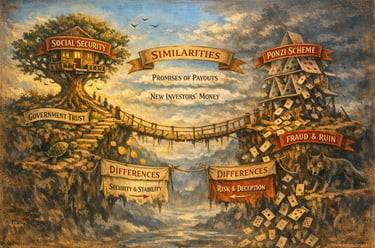
Is Social Security a Ponzi Scheme?
Government and Unalienable Rights
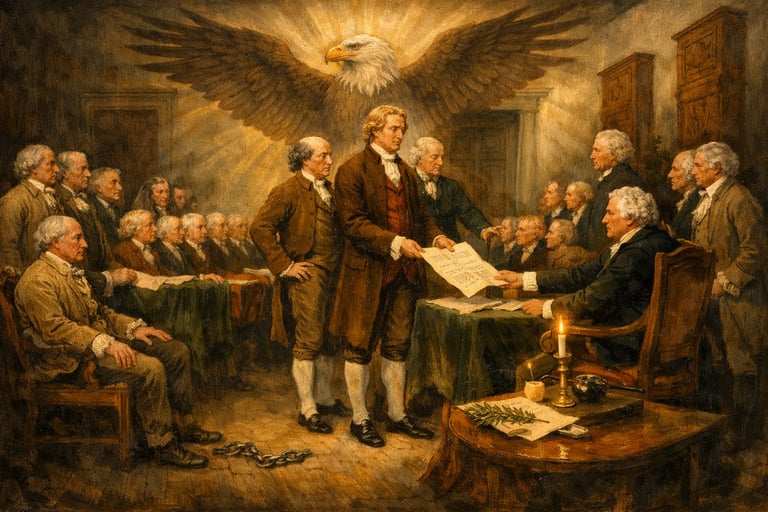
Following the introduction of the Declaration of Independence, in which the founders outlined the reasons for severing ties with England, they proceeded to expand upon their argument. The remainder of the document not only delves more deeply into the justification for separation but, akin to Thomas Paine’s reasoning in Common Sense, also illuminates their concept of the rightful and inherent relationship between government and the governed.
In this document, the members of Congress made no effort to create rights for the colonial citizenry. Instead of establishing new rights in the Declaration of Independence, they affirmed the existence of those rights to which all individuals are inherently entitled. This deliberate wording was intended to draw a clear distinction between natural human rights and those granted by human governments. It is not within the authority of governments to bestow rights that naturally belong to all people. Furthermore, these rights are not only acknowledged as a natural entitlement but are also regarded as self-evident truths—obvious to any reasonable person—that they exist and apply equally to everyone.
To what rights are individuals inherently entitled? While Congress did not attempt to enumerate every natural right, it affirmed that among these are life, liberty, and the pursuit of happiness. These rights were not articulated solely for the benefit of the colonists but were intended to represent universal rights inherent to all humanity. The purpose was to convey a broad vision of human dignity. Rights specific to citizens of the United States are delineated later in the U.S. Constitution.
Severing Ties
Having acknowledged the inherent rights of all human beings, the authors of the Declaration proceeded to assert that when those in positions of authority encroach upon these unalienable rights, it logically follows that the relationship between the citizens and their government must be examined and resolved in a way that meets the approval and satisfaction of the governed.
The foundations for action had been firmly established. England had exceeded its bounds, and despite the colonists’ enduring patience, it became clear that reasoned discourse with King George III or Parliament was futile. Consequently, the founders acknowledged an additional right, one inherently derived from the principles of liberty and the pursuit of happiness. It was not only their right but, indeed, their solemn duty to overthrow any government that refused to honor the natural rights to which they were justly entitled.
A Seeming Inconsistency
This section of the Declaration raises a profound question: How could individuals who owned slaves articulate so eloquently and convincingly the ideals of equality and the unalienable right to liberty? Were figures such as Washington, Franklin, and Jefferson unaware of the stark contradiction between proclaiming liberty for all and the reality that enslaved people were denied that very right? Historical records indicate that a majority of the signatories of the Declaration of Independence were, in fact, slave owners, underscoring the deep inconsistency between their stated principles and their personal practices.
In the eighteenth century, slavery was a widespread institution, and Benjamin Franklin, like many of his contemporaries, owned slaves during his early life. In 1762, while in Europe, one of his slaves escaped, an event that may have influenced his evolving perspective on the injustice of slavery. Although it is uncertain whether this incident directly prompted his opposition, Franklin devoted much of his later life to advocating for its abolition. In collaboration with Benjamin Rush, he co-founded the Pennsylvania Society for Promoting the Abolition of Slavery in 1774. Franklin also authored compelling essays in support of abolition, including *A Plan for Improving the Condition of the Free Blacks* and *An Address to the Public*, the latter being the written version of a speech he delivered in Philadelphia in 1789. Furthermore, it has been reported that Franklin’s will stipulated his children would inherit only if they agreed to free their slaves.
The nature of Alexander Hamilton’s relationship with slavery remains a subject of debate. In a 2020 paper drawing on newly uncovered evidence, Jessie Serfilippi of the Schuyler Mansion State Historic Site in Albany, New York, asserted, “Not only did Alexander Hamilton enslave people, but his involvement in the institution of slavery was essential to his identity, both personally and professionally.”[1] Some historians, such as Christopher Klein, support these conclusions, while others, including Michael Newton and Douglas Hamilton, a descendant, dispute them.
Slave ownership appears inconsistent with Hamilton’s public image, as his biographers often portray him as a steadfast abolitionist. He is frequently described as abhorring slavery and envisioning a future in which it would be eradicated from America. If Hamilton did, in fact, own slaves, it would suggest a profound internal conflict between his political ideals and personal practices. Nonetheless, in the realm of politics, there is little question that he aspired to and firmly believed in an America free from slavery.
Thomas Jefferson, the main author of the Declaration of Independence, owned over two hundred slaves. Yet, despite his upbringing, he seemed to realize early on that slavery clashed with his belief in equality, so powerfully stated in the Declaration. He hoped for the eventual emancipation of slaves and wished it could happen in his lifetime. The problem for Jefferson, a brilliant man, was that he didn’t know how to make it a reality. He once wrote, “…there is nothing I would not sacrifice to a practicable plan of abolishing every vestige of this moral and political depravity.”[2] Still, he didn’t free his own slaves because, in the context of his time, he couldn’t see a way to integrate them into society—they would have had nowhere to go.
Jefferson aspired to establish a colony in Africa where inhabitants could receive a proper education, enabling them to advance in a dignified and respectful manner. His vision also encompassed the emancipation of all enslaved individuals and their establishment as a free and independent people. In 1824, he articulated these ambitions in a letter to his friend Jared Sparks, an American educator who would later serve as President of Harvard College.
We hold these truths to be self-evident, that all men are created equal, that they are endowed by their Creator with certain unalienable rights, that among these are life, liberty, and the pursuit of happiness. That, to secure these rights, governments are instituted among men, deriving their just powers from the consent of the governed. That, whenever any form of government becomes destructive of these ends, it is the right of the people to alter or to abolish it, and to institute new government, laying its foundation on such principles, and organizing its powers in such form, as to them shall seem most likely to affect their safety and happiness.
In the disposition of these unfortunate people, there are two rational objects to be distinctly kept in view. 1. the establishment of a colony on the coast of Africa, which may introduce among the Aborigines the arts of cultivated life, and the blessings of civilisation and science. by doing this, we may make to them some retribution for the long course of injuries we have been committing on their population. and considering that these blessings will descend to the ‘nati natorum, et qui nascentur ab illis,’ (meaning: the children of our children and those who will be born of them), we shall, in the long run, have rendered them perhaps more good than evil. to fulfil this object the colony of Sierra leone promises well, and that of Mesurado adds to our prospect of success. under this view the colonization society is to be considered as a Missionary society, having in view however objects more humane, more justifiable, and less aggressive on the peace of other nations than the others of that appellation.
The 2d object, and the most interesting to us, as coming home to our physical and moral characters, to our happiness and safety, is to provide an Asylum to which we can, by degrees, send the whole of that population from among us, and establish them under our patronage and protection, as a separate, free and independant people, in some country and climate friendly to human life and happiness.[3]
Prudence, indeed, will dictate that governments long established should not be changed for light and transient causes; and, accordingly, all experience has shown, that mankind are more disposed to suffer, while evils are sufferable, than to right themselves by abolishing the forms to which they are accustomed.
But, when a long train of abuses and usurpations, pursuing invariably the same object, evinces a design to reduce them under absolute despotism, it is their right, it is their duty, to throw off such government, and to provide new guards for their future security. Such has been the patient sufferance of these colonies; and such is now the necessity which constrains them to alter their former systems of government. The history of the present King of Great Britain is a history of repeated injuries and usurpations, all having in direct object the establishment of an absolute tyranny over these states. To prove this, let facts be submitted to a candid world.
The letter was extensive, with Jefferson outlining his strategies for achieving his proposals in considerable detail. It is accessible for viewing on various online platforms. Regrettably, Thomas Jefferson passed away approximately two years after composing these words. It may be reasonable to suggest that those who have judged him harshly might reconsider their assessment of his character. It is fair to assert that, without the contributions of individuals like Thomas Jefferson, who died four decades prior to emancipation, the liberation of enslaved people might have been significantly delayed.
Without exploring the numerous individual narratives, the same can reasonably be said of other signers of the Declaration of Independence. At the time of its signing, it is plausible to conclude that many, if not most, of these men comprehended the profound consequences of the document. For them, the language they endorsed implicitly encompassed the eventual abolition of slavery, a principle they recognized within its words.
________________________
[1] Schuessler, Jennifer, citing Jessie Serfilippi, New York Times, Alexander Hamilton, Enslaver? New Research Says Yes | https://www.nytimes.com, Accessed May 26, 2026
[2] Jefferson, Thomas, Thomas Jefferson on Slavery https://studyboss.com/essays/ thomas-jefferson-on-slavery.html, , accessed May 26, 2026
[3] Jefferson, Thomas, Founders Online, From Thomas Jefferson to Jared Sparks, 4 February 1824,, https://founders.archives.gov/documents/Jefferson/98-01-02-4020, accessed May 6, 2026
------------------------------------------------------------------------------If you enjoyed this article, please encourage your friends to visit us here at constitutionmatters.net where the Constitution really does matter. Also, if you appreciate the articles and insights provided here, feel free to contribute to the cause by clicking below.
This book will truly enhance your understanding of the Declaration of Independence and the United States Constitution. Click the button below to check it out.
___________________________________________________________________________________________________________________________________________________________________________________________________


Feel free to visit restoretheword.com
Contact
Questions? Reach out anytime.
Email:
contact@constitutionmatters.net
© 2025. All rights reserved.