The Rise of Populism in America - The Great Divide
Political Populism - Two Views in Conflict
POLITICS
Steven A Carlson
7 min read


To see a list of all commentaries, click the above picture.


Proposal for the 28th Amendment
Is Social Security a Ponzi Scheme?


Insights into the Declaration of Independence
Wolf in Sheep's Clothing
Understanding Political Populism
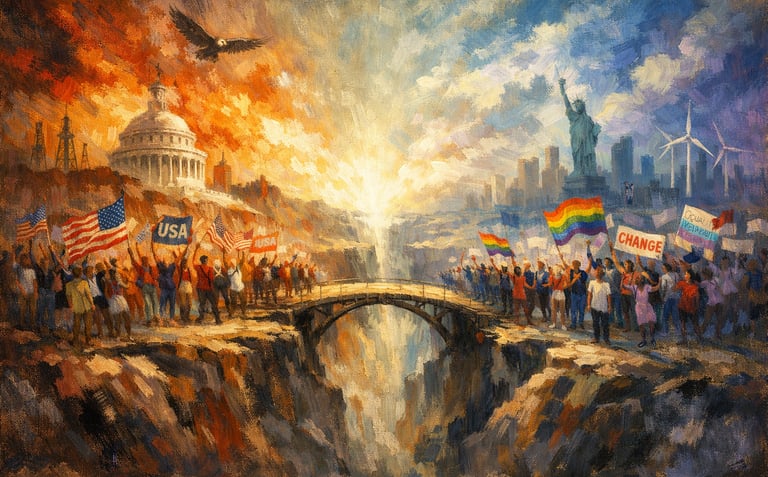
If you pay any attention to politics in America, it is likely that you have heard the term populism, or political populism, tossed around in recent years. I know it is a favorite term of people like Dr. Steve Turley, who regularly uses it on his podcast, generally when discussing the MAGA movement in America that is associated with supporters of Donald Trump. Certainly, Dr. Turley is correct. The MAGA movement is a prime example of political populism. However, it is not the only form of political populism, and it is not the only example of populism in America today.
In general, political populism is an us-versus-them philosophy. The key question is: Who counts as us, and who counts as them? Populism appears on both the conservative and liberal sides of politics, with the main difference being how each side defines those two groups. Where populism is concerned, the us in the equation can be identified as what might be considered the common man (or woman), although the common man on these two sides view life from fundamentally different, and even conflicting perspectives.
In us-versus-them, a single word defines each of the two participants. The word us always refers to the common man. Who, then, is the opposition in the us-versus-them scenario? This would be those who are considered the elites in society. The difference between these two political perspectives is better understood once we identify those who count as elites. That definition varies depending on which side of the political aisle is your home.
The Left Side of the Political Spectrum
On the liberal (left) side of the political aisle, the elite are simply the wealthy in America. It is those who have earned/accumulated vast storehouses of assets who, according to the common man, are greedy, undeserving of their wealth, and ought to rightfully be forced to share that wealth with those who have less. Indeed, this economic inequality is the driving force behind populism on the left. This philosophy has reared its head recently in comments from leftist politicians with statements like, billionaires should not exist in America. The argument is that, once a person reaches that level of wealth, much of it should be taken from them and distributed to the less fortunate (through government programs, of course).
From a leftist perspective, the wealthy are the primary opposition, although this philosophy does at times touch certain social issues on the periphery. These may involve what they see as social injustices (racial inequality, etc.). However, such issues ultimately stem from the economic inequality mentioned above. There is also an inclination in leftist philosophy to attempt to silence opposing views. Open debate on issues is often not acceptable because, in their view, liberalism is the only reasonable voice.
The rise of leftist populism has become prominent in what has come to be known in America as Democratic-Socialism. It has been spearheaded over the past decade by Bernie Sanders of Vermont. He has run for the office of president twice preaching this philosophy and has had a deep impact on the Democrat Party. Recently, he has had others jump on the bandwagon including the likes of Representative Allexandria Ocasio-Cortez of New York and Senator Elizabeth Warren of Massachusetts. Even more recently, this movement has garnered support in places like New York City where Zohran Kwame Mamdani, a self-proclaimed Democratic-Socialist, won the office of Mayor of New York in 2025.
The idea of a billionaire tax (a.k.a., wealth tax) has surfaced recently. It seems in California, a billionaire tax proposal will appear on the 2026 November ballot. It will likely pass since most voters are not billionaires and many undoubtedly believe they will be the beneficiaries of such a tax. A similar tax is also being proposed at the federal level. However, whether such a tax can withstand constitutional scrutiny remains to be seen.
Ultimately, it is economic envy that drives leftist populism, and the movement has strengthened especially over the past couple of years. Under the hood, however, Democratic-Socialism is simply socialism. Consequently, populism on the left can be defined as socialism and many are beginning to proudly identify as such. The question is whether socialism can survive, and even thrive, in a constitutional republic since it seems contrary to the very fabric of the U.S. Constitution.
The Right Side of the Political Spectrum
We now know that those on the left see the elite in the us-versus-them scenario as the wealthy in America. Who, then, constitutes the elite when it comes to the conservative (right) side of the aisle? It is certainly not the wealthy who are demonized. On the contrary, conservatives tend to celebrate success. In fact, the very idea behind the founding of this country was that each person should have an equal opportunity to capitalize on their abilities and achieve the greatest success possible.
For conservatives, particularly where populism is concerned, it is the political elite who are seen as the opposition for the common man. In Washington, and in state and local governments around the country, government officials often see themselves as superior to their constituents, believing they know what is best for the country. They tend to seek to rule over the masses rather than serve the citizens who voted them into office. In fact, it isn’t always elected officials who seek to lord over the masses. At times it is unelected officials (often referred to as the deep state), appointed to assorted positions, who make decisions that seem detrimental to the well-being of the nation.
On the right side of the aisle, it is these officials (both elected and unelected) who are in view when it comes to us-versus-them. While the average conservative (common man) both respects and reveres the U.S. Constitution, the political elite are sure to not allow that document to interfere with their political agenda. Rather than serving the people, their objective is often to demand subservience.
Unlike those on the left, conservatives tend to not only welcome, but encourage, open debate. As with the balance of the U.S. Constitution, they take seriously the freedom of speech (especially political speech) that is protected by the First Amendment. They believe in political debate not simply because the U.S. Constitution protects such speech, but also because they believe their political positions can withstand the test of open dialogue.
Can the Two Philosophies Co-exist?
No one can accurately predict the political future in America. On the other hand, no one can stop what may be coming. It is my view that these two philosophies cannot comfortably co-exist long-term. While both the liberal (Alexander Hamilton and John Adams) and conservative (Thomas Jeffersonnand Patrick Henry) perspectives could be seen even in the founding years, the major factor leading to diverging trajectories began in the 1930’s with the implementation of Roosevelt’s New Deal. Since that time, the left has been on a collision course with the U.S. Constitution. It is a course that has eventually (and inevitably) led to the rising of Democratic-Socialism in this country.
Some have suggested that the strength of conviction on each side of the aisle could lead to violence in America. Indeed, we have already seen that violence beginning to emerge. Still, it is my hope and prayer that such conflict will be limited. After all, this would not be a conflict of territories as we saw in the Civil War. In today’s America, it would pit neighbor against neighbor, and I have no desire to go to war with my liberal friends.
The fruit of these conflicting philosophies has already begun to take shape. In a recent Gallup poll, it was discovered that 66% of Democrats have a favorable view of socialism. Only 42% of Democrats have a favorable view of capitalism – the economic foundation built into the U.S. Constitution. This translates into what could be seen as a major split in the Democrat Party, and it is a split that is not easily overcome. Those Democrats who view capitalism favorably (often called blue-dog Democrats) are generally conservative at heart. Most will never be persuaded to position themselves with what could be referred to as far-left liberals who are embracing socialist ideas.
On the other hand, the populist movement on the right is pretty much embodied in President Trump who currently enjoys very high favorability rating from his supporters (MAGA/Republican Party). What this means is that the populist movement on the right has far stronger support than that of the left. In fact, there has been a tremendous shift in party allegiance over the past decade with the Republican Party strengthening while registration for the Democrat Party is faltering, at least partly due to the introduction of Democratic-Socialism. It is likely that we will see this trend continue. While the U.S. will likely always maintain its bastions of liberalism like New York and Minnesota, it appears that conservative populism is, indeed, the future of America.
------------------------------------------------------------------------------If you enjoyed this article, please encourage your friends to visit us here at constitutionmatters.net where the Constitution really does matter. Also, if you appreciate the articles and insights provided here, feel free to contribute to the cause by clicking below.


This book will truly enhance your understanding of the Declaration of Independence and the United States Constitution. Click the button below to check it out.
___________________________________________________________________________________________________________________________________________________________________________________________________


Feel free to visit restoretheword.com
Contact
Questions? Reach out anytime.
Email:
contact@constitutionmatters.net
© 2025. All rights reserved.